The Benefits of All-on-4 Dental Implants: A Full-Arch Restoration Checklist
Medically reviewed by Dr. Alexander V. Antipov, DDS — Board-Certified Oral & Maxillofacial Surgeon · Diplomate, American Board of Oral & Maxillofacial Surgery (ABOMS) · California Dental License #50724
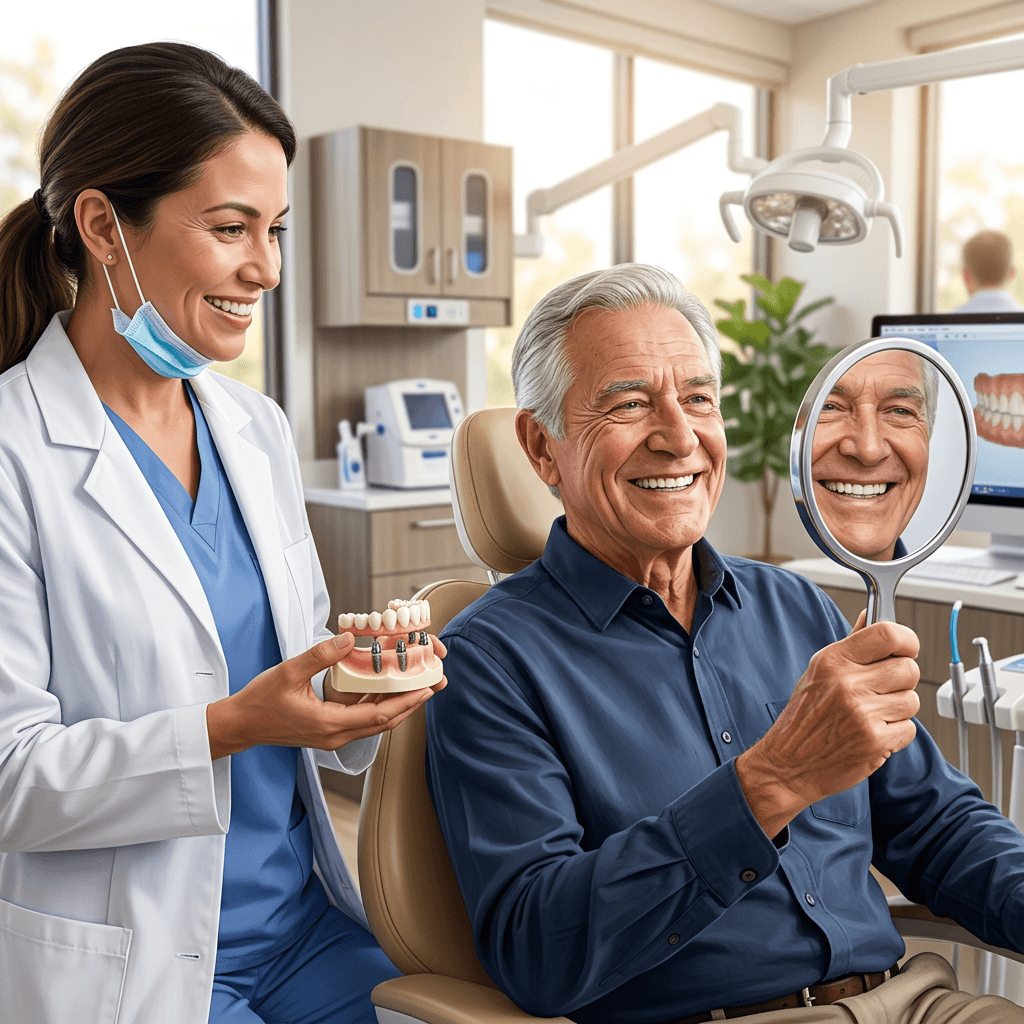
The core benefits of All-on-4 dental implants are structural and immediate: four strategically angled titanium posts support an entire arch of fixed teeth — preserving your jawbone and facial contours, restoring near-natural bite force, and usually delivering functional teeth the same day as surgery, explains Dr. Alexander Antipov, a board-certified oral and maxillofacial surgeon in Roseville, CA. Because the two rear implants are tilted to maximize contact with your densest available bone, most patients qualify without the bone grafting that traditional multi-implant plans require — even after years of denture wear. This guide breaks the benefits into a practical checklist — structural, functional, and efficiency advantages — then walks through the candidacy questions that determine whether All-on-4 is the right restoration for you.
This article is for general education and is not a substitute for a clinical evaluation. Whether All-on-4 fits your case depends on your bone volume, oral health, and bite — all assessed with 3D imaging at an in-person consultation.
The Benefits at a Glance: All-on-4 vs. Dentures vs. Traditional Implants
Three paths to replacing a full arch — and why All-on-4 has become the modern standard for most full-arch patients (if you are weighing four posts against six, our All-on-4 vs. All-on-6 comparison covers that decision separately):
| Factor | Traditional dentures | 8–10 individual implants | All-on-4 |
|---|---|---|---|
| Bite force restored | Roughly 10–20% of natural | Near-natural | Near-natural (≈90–95%) |
| Bone grafting | Not applicable — bone keeps shrinking | Frequently required, adds months | Usually avoided via angled rear implants |
| Surgical stages | None (but no bone benefit) | Multiple surgeries over 6–12+ months | One surgery; teeth typically the same day |
| Bone preservation | None — resorption continues | Yes | Yes — all four posts stimulate the jaw |
| Stability | Slips; needs adhesive | Fixed | Fixed — cleaned like natural teeth |
| Typical cost profile | Lowest upfront, recurring relines/replacements | Highest | Lower than 8–10 implants; all-inclusive quotes available |
Structural Benefits: Bone Preservation and Facial Integrity
When teeth are lost, the jawbone loses the chewing stimulation that maintains it, and the body steadily resorbs the bone — the mechanism behind the “sunken” facial collapse of long-term denture wear. All-on-4's titanium posts fuse with the jaw (osseointegration) and restore that stimulation across the arch, halting resorption and preserving your facial contours. The American Dental Association's overview of dental implants explains the root-replacement principle behind this.
The signature engineering benefit is the angled placement of the two posterior implants — tilted up to 45 degrees to anchor in the densest bone available. That is why patients told they “lack the bone” for traditional implants frequently qualify for All-on-4 without grafting; our guide to implants with severe bone loss covers the techniques in depth.
Functional Benefits: Eating, Speaking, and Living Normally
The functional upgrade over dentures is not incremental — it is categorical. A traditional denture delivers roughly 10–20% of natural chewing force; a fixed All-on-4 bridge restores close to full function, putting steak, apples, and crusty bread back on the menu permanently. Because the bridge is anchored to bone, there is no slipping mid-sentence, no clicking, and no adhesive ritual — and the upper version leaves the palate open, restoring full taste and temperature sensation that a denture plate blocks.
Daily maintenance mirrors natural teeth: brush twice a day and use a water flosser under the bridge. For a deeper comparison of the fixed-bridge experience against removable options, see our guides to All-on-4 explained and fixed versus removable permanent dentures.
The Efficiency Benefit: Same-Day Teeth, Faster Recovery
Because four implants replace the eight to ten of older full-arch protocols — and grafting is usually unnecessary — the entire surgical phase compresses into a single visit under IV sedation. When the implants achieve strong primary stability at placement, a fixed set of functional temporary teeth is attached the same day — the teeth-in-a-day protocol — so you never spend a day without a smile.
Recovery is correspondingly light: most patients return to work within two to three days, follow a soft-food protocol while the bone integrates over 3–6 months, then receive the final zirconia or hybrid bridge. Our All-on-4 recovery timeline maps the healing phase week by week, and 10-year survival rates of 95–98% back the long-term durability claim.
Is All-on-4 Right for You? The Candidate Checklist
If you answer yes to most of these, you are likely a strong candidate:
- — Are you missing most or all teeth in one arch, or living with failing teeth that need extraction?
- — Do you struggle with loose or painful dentures — adhesives, slipping, sore spots?
- — Have you been told you lack the bone for traditional implants? (Angled placement often solves this without grafting.)
- — Are you in good general health for a routine surgical procedure, with chronic conditions like diabetes well-managed?
- — Is your gum health under control? Active periodontal disease is treated before implant surgery.
- — Are you a non-smoker, or willing to pause? Nicotine interferes with osseointegration.
Why Patients Choose Dr. Antipov in Roseville
All-on-4's benefits are only as reliable as the surgical judgment behind them — implant angulation, primary stability, and bite calibration decide whether the restoration lasts decades. Dr. Alexander Antipov is a board-certified oral and maxillofacial surgeon and Diplomate of the American Board of Oral and Maxillofacial Surgery, with hospital-based residency training and a practice focus on full-arch, complex, and revision cases from failed full-arch work elsewhere. He plans every case personally on 3D CBCT imaging and performs the surgery himself.
Patients come from Rocklin, Granite Bay, Folsom, El Dorado Hills, and across Sacramento. Pricing is transparent and all-inclusive, backed by a price-match guarantee, our breakdown of All-on-X implant costs shows what drives the numbers, and our guide to paying for dental implants walks through financing and insurance strategy for full-arch cases.
Frequently Asked Questions
How long do All-on-4 dental implants last?
The titanium posts are designed to last a lifetime, with 10-year survival rates of 95–98%. The prosthetic bridge may need replacement after many years of normal wear, but the integrated implants typically remain for decades. Regular professional cleanings and good hygiene are the biggest longevity factors.
Is the All-on-4 procedure painful?
No — the surgery is performed under IV sedation with local anesthetic, and most patients remember little of it. Some swelling and mild soreness in the days afterward is normal and typically managed with over-the-counter medication, fading substantially within 72 hours.
What is the main benefit of All-on-4 over regular dentures?
Fixed stability plus bone preservation. A denture rests on shrinking gums, delivers 10–20% of natural bite force, and accelerates bone loss; an All-on-4 bridge is anchored to implants, restores near-natural chewing power, and stimulates the jawbone so your facial structure holds its shape.
What is the difference between All-on-4 and All-on-6?
The number of supporting posts and how bite force is distributed. All-on-4 is the standard for most patients; All-on-6 may be recommended for very high bite force or particular bone-density situations. 3D imaging determines which configuration gives your anatomy the best long-term stability.
Can I get All-on-4 with bone loss or osteoporosis?
Often, yes. The tilted posterior implants are specifically designed to maximize contact with your densest available bone, frequently eliminating the need for grafting even after years of resorption. Well-managed osteoporosis is not an automatic disqualifier — a CBCT scan at the consultation settles candidacy.
How do I clean and maintain an All-on-4 bridge?
Much like natural teeth: brush twice daily with a non-abrasive paste and clean under the bridge with a water flosser or specialized floss. Regular professional checkups monitor the gum tissue and prevent peri-implantitis, the implant-focused gum disease that threatens the foundation.
What happens if one of the four implants fails?
It can typically be replaced after a short healing period. Failure rates are low, but smoking and uncontrolled health conditions raise the risk — which is why candidacy screening matters. Dr. Antipov's practice focuses on complex and revision cases, so issues are caught early through scheduled integration checks.
How soon can I return to work after All-on-4 surgery?
Most patients are back to work and light activity within two to three days. You leave surgery with a functional temporary bridge, follow a soft-food diet for the first weeks, and progress to unrestricted eating once the final bridge is attached after integration.
Ready to See If All-on-4 Fits Your Checklist?
Schedule a free implant consultation with Dr. Antipov in Roseville — you'll get 3D CBCT imaging, a clear answer on your candidacy without grafting, and transparent, all-inclusive pricing backed by a price-match guarantee. Restrictions apply.
Book a Free Consultation