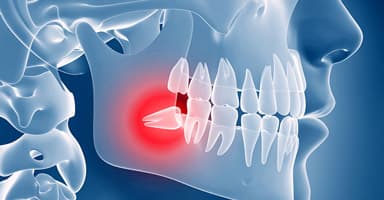
Tooth extractions — gentle removal, expert hands
From straightforward extractions to deeply impacted molars and canines, Dr. Antipov removes teeth safely with sedation options for anxious patients — and plans every site for what comes next.
What does an oral surgeon do for a tooth extraction?
An oral and maxillofacial surgeon removes teeth that are damaged, infected, impacted, or in the way of other treatment — and does it with surgical precision when a tooth is broken at the gumline, has curved roots, or is buried in bone. Dr. Antipov performs simple extractions, surgical extractions, and the removal of impacted molars and canines, with oral, nitrous, or IV sedation available for patients who feel anxious.
Because Dr. Antipov is also a full-arch implant surgeon, he plans every extraction with the future in mind — preserving bone and tissue so that an implant, bridge, or denture can be placed cleanly later if you need one.
When an extraction is recommended
Impacted molars & canines
Teeth trapped in bone or under the gum that cannot erupt normally — removed surgically to prevent infection, cysts, and damage to neighboring teeth.
Severely broken or decayed teeth
Teeth fractured below the gumline or destroyed by decay beyond what a crown or root canal can save.
Infection or abscess
Teeth with persistent infection that has not responded to other treatment and threatens surrounding bone.
Pre-implant or pre-denture preparation
Removing non-restorable teeth as the first step toward dental implants, full-arch restoration, or dentures.
Exposed-canine surgery for orthodontics
Dr. Antipov works with orthodontists across the region who refer adults and children for exposed-bone surgery to retrieve impacted canine teeth so they can be guided into place with braces.
Impacted canine exposure
Surgically uncovering an impacted canine and attaching an orthodontic bracket so your orthodontist can move it into the arch.
Coordinated with your orthodontist
Timing and technique are planned together with your orthodontic treatment for a smooth, predictable result.
Frequently asked questions
Will the extraction hurt?
The area is fully numbed before any work begins, so you should not feel pain during the procedure. For anxious patients or more involved surgical extractions, Dr. Antipov offers oral sedation, nitrous oxide, and IV sedation so the experience is comfortable.
What is the difference between a simple and a surgical extraction?
A simple extraction removes a tooth that is fully visible and can be loosened and lifted out. A surgical extraction is needed when a tooth is broken at the gumline, impacted, or has complex roots — it may involve a small incision and, sometimes, sectioning the tooth for gentle removal.
Can I be sedated for my extraction?
Yes. Dr. Antipov holds a California General Anesthesia Permit and provides oral sedation, nitrous oxide, and IV sedation in-office, which is especially helpful for fearful patients and for the removal of impacted teeth.
Will I need an implant after the tooth is removed?
Not always, but if you do, planning ahead matters. Dr. Antipov preserves bone and tissue during the extraction so that a future implant, bridge, or denture can be placed in the best possible foundation.
Schedule Your Consultation
Meet Dr. Antipov and discuss your treatment options, including advanced 3D imaging and a personalized treatment plan.
Free 3D CT Scan · No Obligation · Flexible Financing · Roseville, CA · Restrictions apply