How to Fix Loose Dentures Permanently: The 2026 Stability Guide
Medically reviewed by Dr. Alexander V. Antipov, DDS — Board-Certified Oral & Maxillofacial Surgeon · Diplomate, American Board of Oral & Maxillofacial Surgery (ABOMS) · California Dental License #50724
The only permanent fix for loose dentures is anchoring them to dental implants — relines and adhesives treat the symptom while the jawbone underneath keeps shrinking, explains Dr. Alexander Antipov, a board-certified oral and maxillofacial surgeon in Roseville, CA. When natural tooth roots are gone, the jaw loses the chewing stimulation that maintains bone, and the body steadily reabsorbs it; the ridge your denture rests on literally gets smaller every year, which is why a plate that fit perfectly can wobble twelve months later. Implants break that cycle: titanium posts fuse with the bone, restore the missing stimulation, and give your replacement teeth a fixed anchor that no adhesive can match. This guide explains why the loosening happens, why temporary fixes fail, and how the two implant-based solutions — removable snap-in overdentures and fixed All-on-4 bridges — compare so you can choose the right permanent path.
This article is for general education and is not a substitute for a clinical evaluation. The right stabilization option for you depends on your bone volume, oral health, and bite — all assessed with 3D imaging at an in-person consultation.
Temporary Patches vs. the Permanent Fix at a Glance
Every common response to a loose denture falls into one of two categories — managing the symptom or fixing the foundation:
| Approach | What it does | How long it lasts | Does it stop bone loss? |
|---|---|---|---|
| Denture adhesive | Glues the plate to shrinking gums | Hours — reapplied daily | No |
| Soft reline | Cushions the fit against the changed ridge | Months | No |
| Hard reline / new denture | Re-molds the base to today's ridge shape | 1–2 years before the ridge changes again | No |
| Snap-in overdenture (2–4 implants) | Locks the denture onto implant anchors | Decades, with attachment inserts replaced periodically | Yes — implants stimulate the bone |
| Fixed All-on-4 bridge (4+ implants) | Replaces the denture with non-removable teeth | Designed to last decades | Yes — maximum stimulation |
Why Dentures Keep Getting Loose: The Bone-Loss Loop
A loosening denture is rarely a flaw in the denture — it is biology. Natural tooth roots transmit chewing pressure into the jaw, and that pressure is the signal that tells the body to maintain bone density. Remove the roots and the signal stops: the jaw ridge resorbs, the gum tissue over it changes shape, and the denture molded to last year's anatomy starts to rock and slip. The National Institute of Dental and Craniofacial Research's overview of dental implants explains how implants restore that root function.
A reline refits the plate to the shrunken ridge — but because the biological signal is still missing, the bone keeps receding under the new material, and the cycle repeats. Left unaddressed, progressive resorption thins the ridge, changes the facial profile toward the “sunken” look, and makes future implant treatment more complex. Patients with years of denture wear should read our guide to implant options with severe bone loss — advanced techniques anchor implants successfully in most of these cases.
Why Implants Are the Permanent Solution
Titanium implants work because of osseointegration: living bone grows directly onto the implant surface and locks it in place, exactly as it once held your tooth roots. That fusion does two things no adhesive or reline can. First, it gives your replacement teeth a mechanical anchor — they cannot slip during a meal or a conversation. Second, it restores the chewing stimulation that maintains the jawbone, halting the resorption that made your denture loose in the first place.
The functional difference is dramatic. Traditional dentures deliver roughly 10–20% of natural chewing force — which is why steak and apples quietly disappear from the menu. Implant-anchored teeth restore most to all of it, along with clear speech: with the prosthetic fixed to bone, your tongue and lips move naturally, with no clicking or whistling from a shifting plate. Our side-by-side comparison of implants versus dentures quantifies the differences in detail.
Snap-In Overdentures vs. Fixed All-on-4: Choosing Your Path
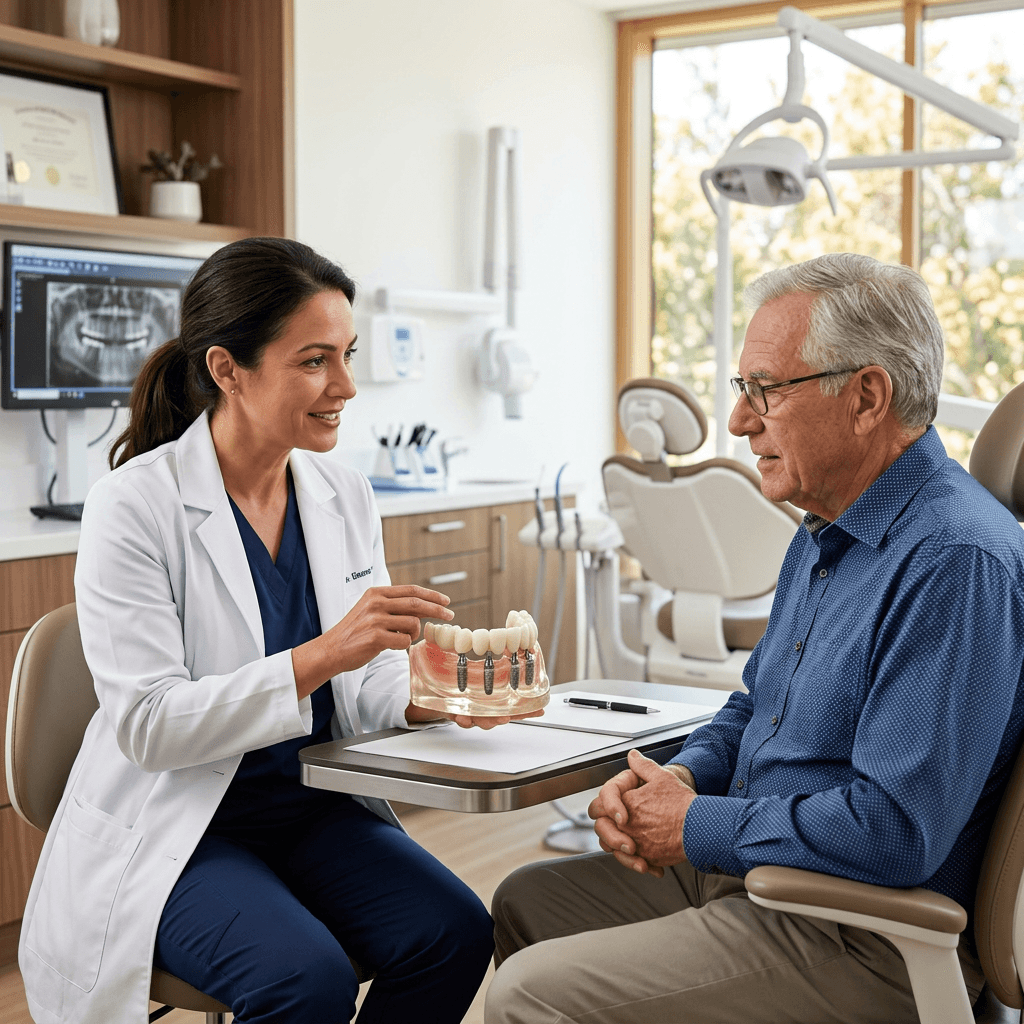
Both implant solutions end the adhesive era; they differ in how permanent the teeth themselves are. A snap-in overdenture clicks onto 2–4 implants — rock-solid in use, removed at night for easy cleaning, and the more accessible investment. It is the natural upgrade for patients who want implant stability while keeping a removable appliance. Note that an upper snap-in still covers part of the palate.
A fixed All-on-4 bridge is the fully permanent option: a complete arch of non-removable teeth secured to four or more implants, cleaned in the mouth like natural teeth, with an open palate that restores full taste and temperature sensation. It delivers the highest chewing power and the most natural feel. Our deeper comparison of fixed versus removable permanent dentures walks through the trade-offs in detail — and if you are still surveying the whole landscape of options, start with our overview of denture alternatives that actually work.
The Transition: From Loose Denture to Fixed Smile
The journey is methodical and shorter than most patients expect. It starts with a 3D CBCT scan that maps your bone in high resolution and lets the surgeon plan each implant position to sub-millimeter precision. Surgery is performed under IV sedation — and in many full-arch cases, a functional set of fixed temporary teeth is attached the same day, so you never go without a smile. Over the next 3–6 months the implants fuse with your bone; then the temporaries are swapped for your final custom teeth.
Recovery is manageable: mild swelling for the first 48–72 hours, a soft-food protocol while the implants integrate, and scheduled follow-ups to confirm healing is on track — our guide to normal healing versus infection covers exactly what to expect.
Why Patients Choose Dr. Antipov in Roseville
Converting a resorbed, denture-worn jaw into a stable implant foundation is surgically demanding — bone quality varies, anatomy is compressed, and precision determines whether the result lasts decades. Dr. Alexander Antipov is a board-certified oral and maxillofacial surgeon and Diplomate of the American Board of Oral and Maxillofacial Surgery, with hospital-based residency training and a practice focus on full-arch and complex cases. He plans every case personally on 3D imaging, operates under IV sedation, and follows your integration through to the final teeth at his Roseville office.
Patients come from Rocklin, Granite Bay, Citrus Heights, Folsom, El Dorado Hills, and across Sacramento. Pricing is transparent and all-inclusive, backed by a price-match guarantee — and when you weigh the long-term cost of relines, adhesives, and replacement dentures, implants are often the better financial decision too. Our guide to paying for dental implants covers financing and insurance strategy.
Frequently Asked Questions
Can loose dentures be fixed without implants?
Only temporarily. Adhesives hold for hours, soft relines for months, and a hard reline or new denture for a year or two — but none of them stop the jawbone resorption causing the looseness, so the problem always returns. Dental implants are the only treatment that halts the bone loss and permanently anchors the teeth.
Is the implant procedure painful?
Most patients find it far more comfortable than expected. Surgery is performed under local anesthesia with IV sedation — a monitored “twilight” state most patients barely remember. Post-operative discomfort is typically mild and subsides substantially within 48–72 hours.
Can I get permanent teeth if I already have bone loss?
Usually, yes. Techniques like All-on-4 use strategically angled implants to maximize contact with your remaining bone, often avoiding grafting entirely. 3D imaging locates the densest available bone — many patients told “not enough bone” years ago qualify today.
What is the difference between snap-in dentures and All-on-4?
Removability. A snap-in overdenture clicks onto 2–4 implants and comes out at night for cleaning; an All-on-4 bridge is fixed to four or more implants and only a dentist can remove it. All-on-4 delivers the highest chewing power, an open palate, and the most natural feel; snap-in is the more accessible investment.
Will insurance cover fixing loose dentures permanently?
Many plans partially cover restorative components such as extractions or the prosthetic, while the surgical implant portion varies significantly by policy. Our team verifies your benefits in detail at the consultation and offers financing plus a price-match guarantee to bridge any gap.
Am I too old to switch from dentures to implants?
There is no upper age limit. Overall health and jawbone quality matter far more than age — patients in their 70s, 80s, and beyond routinely complete treatment successfully and regain the ability to eat a full, varied diet.
How do I clean implant-supported teeth?
A fixed All-on-4 bridge is cleaned in your mouth like natural teeth: brush twice daily and use a water flosser under the bridge. A snap-in overdenture comes out at night for brushing with a non-abrasive cleanser, plus gentle cleaning of the attachments in your mouth. Either way, the teeth-in-a-glass routine is over.
What happens if I don't fix my loose dentures?
The bone-loss loop continues: the jaw ridge keeps shrinking, the denture gets looser, and future implant treatment becomes more complex. Over time this can mean chronic gum sores, a progressively sunken facial profile, and nutritional compromise from avoiding foods you can't chew.
Ready to Retire the Adhesive for Good?
Schedule a free implant consultation with Dr. Antipov in Roseville — you'll get 3D CBCT imaging, a clear recommendation between snap-in and fixed options for your anatomy, and transparent, all-inclusive pricing backed by a price-match guarantee. Restrictions apply.
Book a Consultation