Fixing a Failed All-on-4: Revision Surgery Options
Medically reviewed by Dr. Alexander V. Antipov, DDS — Board-Certified Oral & Maxillofacial Surgeon · Diplomate, American Board of Oral & Maxillofacial Surgery (ABOMS) · California Dental License #50724
A failed All-on-4 can almost always be fixed, and often without replacing every implant, explains Dr. Alexander Antipov, a board-certified oral and maxillofacial surgeon in Roseville, CA. A full-arch restoration is a major investment in both your smile and your health, so when it fails, loosens, or simply does not feel right, it is natural to feel discouraged. The encouraging news is that most full-arch problems can be corrected with the right revision plan.
This article is for general education — consult a qualified oral surgeon for a personalized recommendation.
Common Full-Arch Problems
Many full-arch issues affect only the bridge or the bite, not the implants themselves. Typical complaints include:
- — A cracked or worn acrylic bridge
- — An uneven or uncomfortable bite
- — One or more failing implants
- — Gum inflammation around the implants
- — A poor fit that traps food or affects speech
| Problem | Typical Fix |
|---|---|
| Cracked or worn bridge | Repair or replace the prosthesis; consider zirconia |
| Uneven or uncomfortable bite | Redesign the bite on a new bridge |
| One or more failing implants | Remove, repair the site, and place new implants |
| Gum inflammation around implants | Treat the infection before rebuilding |
| Flawed original design | Complete redesign of implant number, position, and bite |
When Only the Bridge Needs Work
If the implants are healthy and integrated, the fix may be limited to the prosthesis. A new bridge can correct the fit, bite, and appearance while keeping your existing implants in place.
Upgrading from acrylic to a stronger material such as zirconia often ends a cycle of repeat fractures. Our guide on zirconia full-arch restorations explains the difference.
When Implants Must Be Replaced
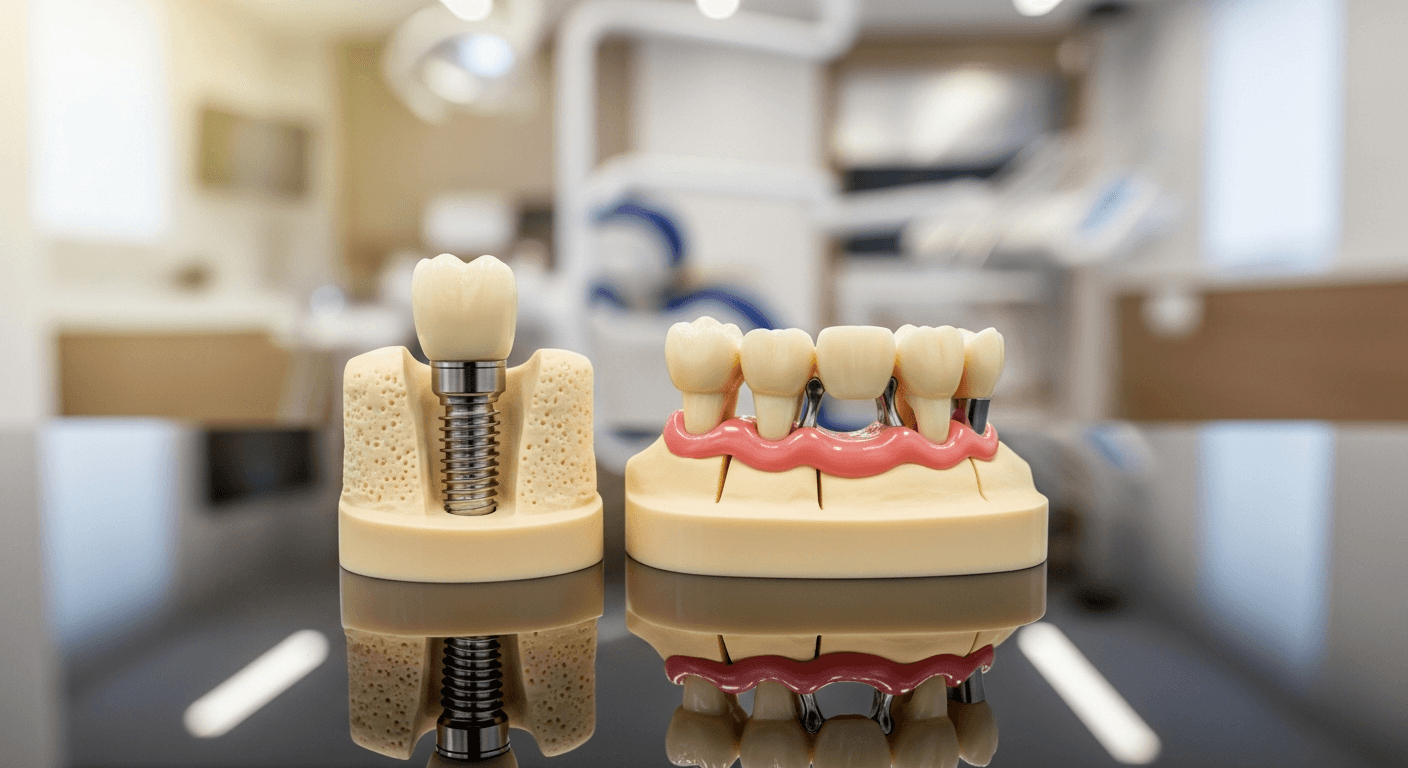
If one or more implants have failed, the revision is more involved. The failed implant is removed, the site is repaired, and a new implant is placed. Replacement planning often includes:
- — Treating any infection first
- — Bone grafting where volume is low
- — Repositioning implants for better support
- — Adding implants for stronger load distribution
When the Original Plan Was Flawed
Some full-arch failures trace back to the original design — too few implants, poor angulation, or a bite that overloads the arch. In these cases a complete redesign is the most reliable path, correcting implant number, position, and bite at once. See how modern planning improves accuracy in our guide to guided implant surgery.
What Recovery Looks Like
Recovery depends on how much rebuilding is needed. A new bridge over healthy implants is quick. A case that requires implant removal and grafting can take several months before final teeth are placed — and a temporary keeps you comfortable throughout.
Frequently Asked Questions
Can my current implants be reused?
Often yes. Healthy, well-integrated implants can support a new bridge. Only the implants that have actually failed need replacement.
Does the whole arch have to be replaced?
Not usually. Healthy, integrated implants can keep supporting a new prosthesis, so only the implants that have actually failed are replaced.
Can a cracked bridge just be replaced?
If the implants are healthy, the fix may be limited to the prosthesis. A new bridge can correct fit, bite, and appearance while keeping your implants in place.
Why do some All-on-4 cases keep failing?
Some failures trace back to the original design — too few implants, poor angulation, or a bite that overloads the arch. These cases need a complete redesign rather than another patch.
Is a failed All-on-4 painful?
Failing implants can cause pain, swelling, or looseness. These are warning signs that warrant a prompt evaluation.
Will I be without teeth during the revision?
No. Most patients wear a temporary throughout, so they are never without teeth.
Can you fix work done at another clinic?
Yes. Evaluating and revising full-arch cases started elsewhere is a routine part of the practice.
Is your full-arch restoration failing?
Dr. Antipov finds the real cause and rebuilds full-arch cases to last. Book a consultation at our Roseville practice to review your options.
Book a Free Consultation