Dental Implants for El Dorado Hills: The Science of Osseointegration
Medically reviewed by Dr. Alexander V. Antipov, DDS — Board-Certified Oral & Maxillofacial Surgeon · Diplomate, American Board of Oral & Maxillofacial Surgery (ABOMS) · California Dental License #50724
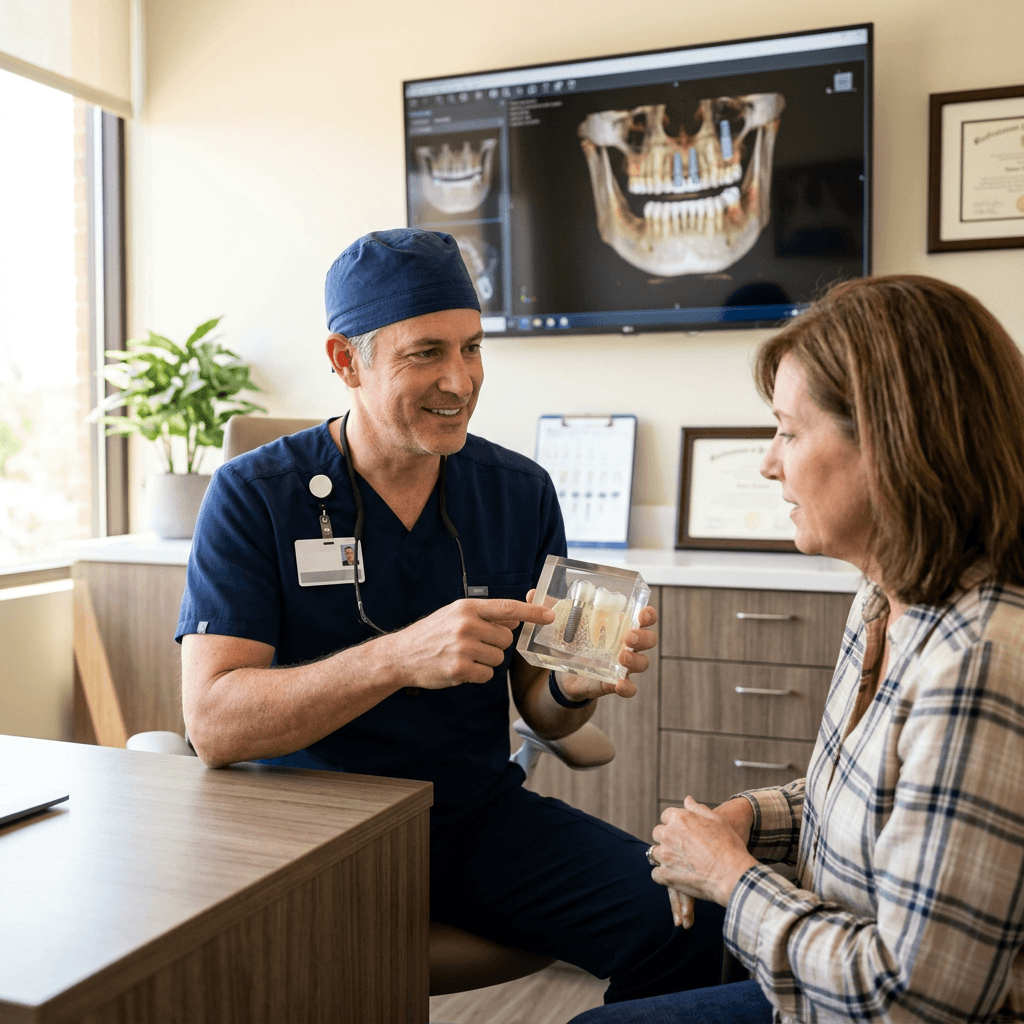
The success of a dental implant is decided by something you never see: osseointegration, the biological process in which your jawbone grows into the implant's surface and locks it in place like a natural tooth root. For El Dorado Hills residents, that fusion — and the surgical precision it demands — is available from a board-certified oral and maxillofacial surgeon about 25 minutes away: Dr. Alexander Antipov places implants at his Roseville, CA office using 3D-guided planning that positions each post where your bone is densest. This guide explains how the bone-to-implant bond actually forms, why even microscopic movement during healing can cause failure, how All-on-4 full-arch restorations use the same biology at scale, and how to evaluate cost so a “cheap” implant doesn't become an expensive revision.
This article is for general education and is not a substitute for a clinical evaluation. Whether an implant will integrate successfully depends on your bone density, oral health, and medical history — all assessed with 3D imaging at an in-person consultation.
Osseointegration at a Glance: What Decides Implant Success
Before comparing providers or prices, it helps to understand what actually has to go right beneath the gumline:
| Factor | Why it matters | How a surgical specialist controls it |
|---|---|---|
| Bone density | The implant must sit in bone strong enough to carry chewing force | 3D CBCT mapping locates the densest available bone before surgery |
| Placement precision | Gaps or misalignment invite bacteria and uneven load | Guided placement to sub-millimeter accuracy |
| Heat and trauma control | Overheated bone dies instead of fusing | Low-trauma surgical protocols that preserve living bone cells |
| Stability during healing | Micro-movement causes soft scar tissue instead of bone | Torque-verified initial stability and a monitored healing plan |
| Systemic health | Healing capacity affects fusion speed and strength | Medical screening and coordination before surgery |
What Osseointegration Actually Is
Osseointegration is not a mechanical fit like a screw held by friction — it is a living, structural bond in which bone cells migrate onto the implant's micro-textured surface and grow into it, until the dental implant is functionally part of your skeleton. Titanium and zirconia are used because bone treats them as friendly scaffolding rather than a foreign object. The process follows a biological timeline: initial cellular attachment in the first weeks, then progressive mineralization over roughly three to six months until the bond can carry full chewing force.
That timeline is why implant dentistry rewards patience and precision over speed. If there is even microscopic movement during the healing window, the body lays down soft fibrous tissue instead of hard bone — the root cause of a “loose” implant that eventually fails. Your choice of implant material also plays a role in how the surface bonds; our comparison of titanium vs. zirconia implants covers the trade-offs.
Why Surgical Precision Decides Whether Fusion Happens
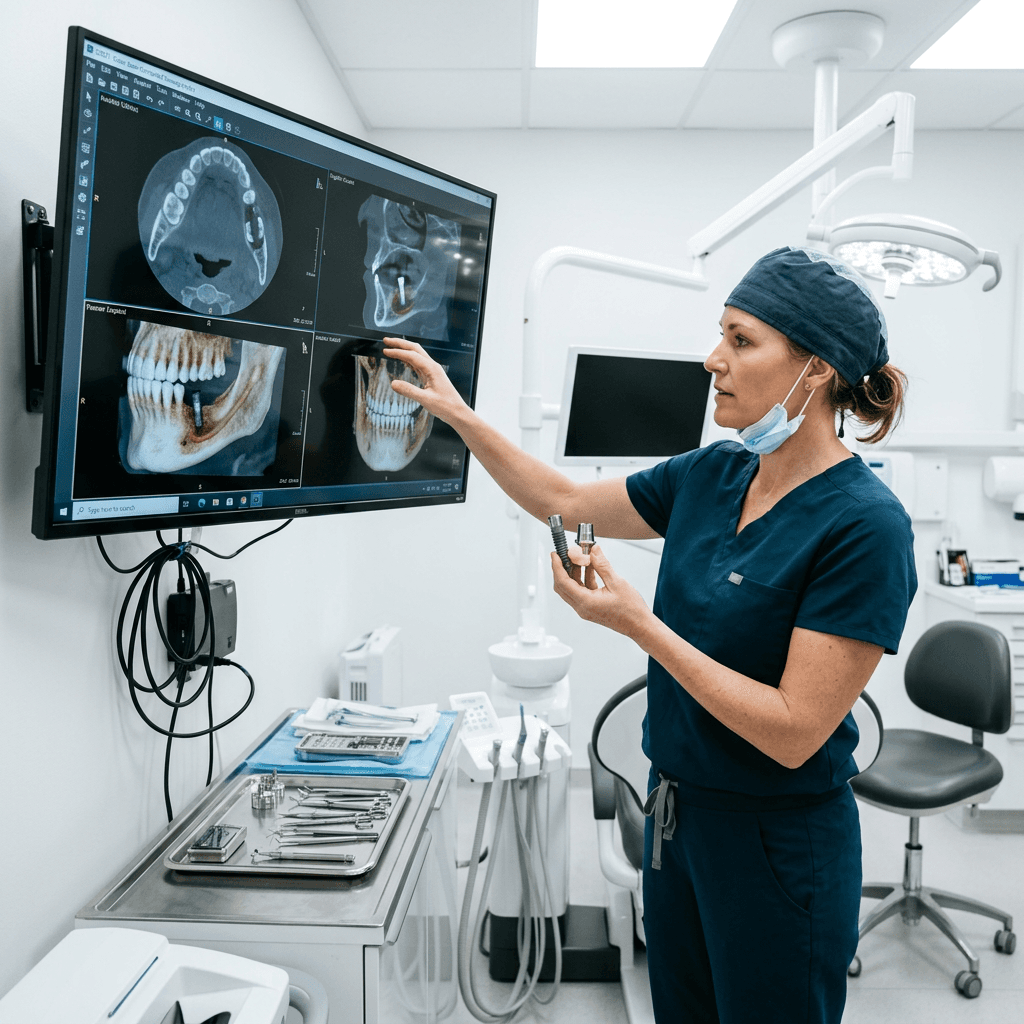
The fusion process can be helped or sabotaged in the operating chair. Preparing the implant site generates heat, and bone cells die at temperatures only slightly above body temperature — so a specialist uses controlled, low-trauma techniques that keep the surrounding bone alive and ready to attach. Placement position matters just as much: guided surgery based on a 3D CBCT scan lets the surgeon set each implant in the exact spot where your bone density is highest, rather than estimating from a flat X-ray.
Dr. Alexander Antipov is a board-certified oral and maxillofacial surgeon and Diplomate of the American Board of Oral and Maxillofacial Surgery — hospital-based surgical residency training beyond dental school. That distinction matters most in complex cases: significant bone loss, failed previous implants, or full-arch reconstruction. When integration has already failed once, the standards are even higher — our guide to dental implant revision surgery explains how specialists rebuild after a failed case. The National Institute of Dental and Craniofacial Research's overview of dental implant care and risks underscores the same point: outcomes depend on proper evaluation, placement, and follow-up.
All-on-4 and Full-Arch: Osseointegration at Scale
The same biology that anchors one tooth can anchor an entire arch. The All-on-4 technique supports a full row of fixed teeth on just four implants by tilting the back two posts up to 45 degrees, maximizing contact with the densest bone in the jaw. That geometry often eliminates the need for bone grafting even after years of denture-related bone loss — and because the implants achieve strong initial stability, many patients receive a fixed provisional bridge the same day as surgery.
Unlike traditional dentures, which rest on the gums and let the jawbone shrink beneath them, implant-anchored teeth load the bone the way natural roots do — preserving facial structure instead of accelerating its collapse. For patients who prefer a removable option, snap-in overdentures use the same osseointegrated anchors with a click-on prosthetic.
What Implants Should Cost Near El Dorado Hills
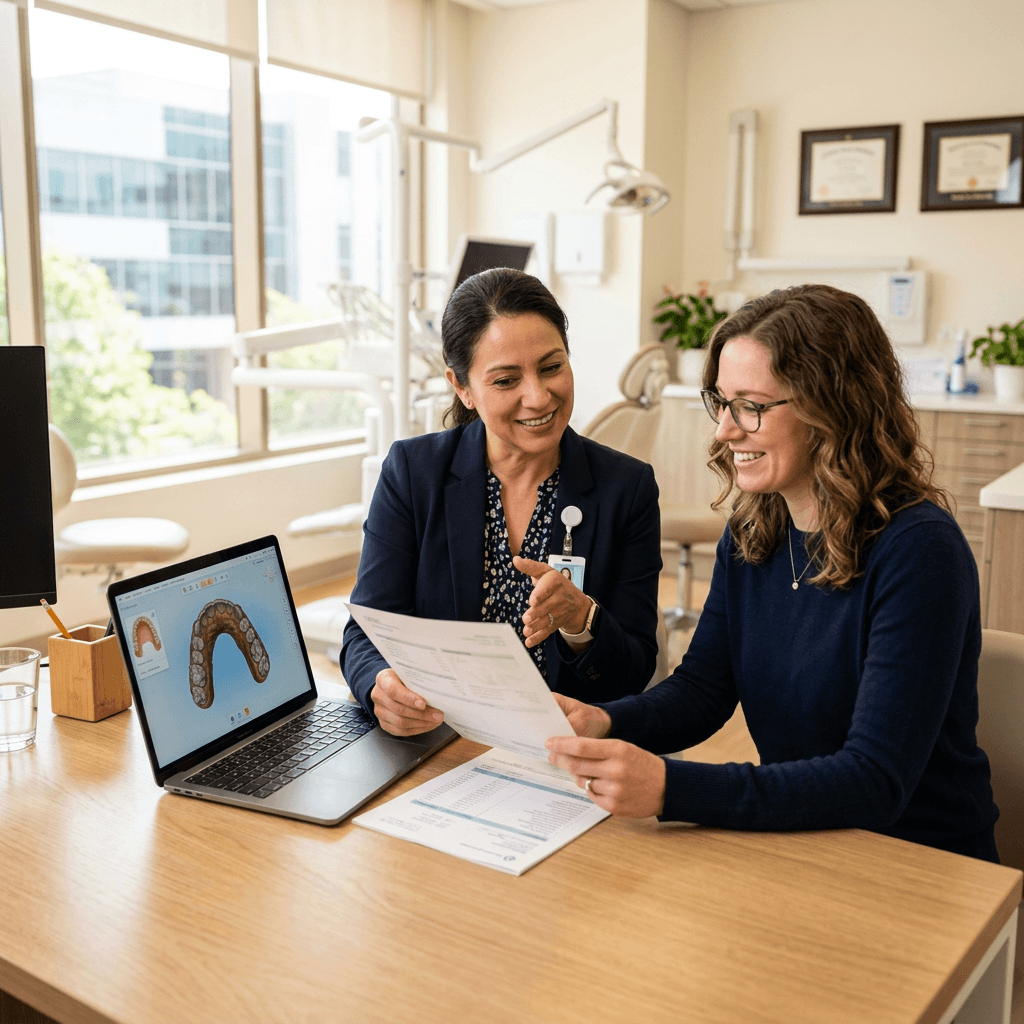
A quoted implant price only means something if you know what it includes. A complete, biologically sound restoration involves 3D diagnostic imaging, the surgical placement itself, a medical-grade titanium or zirconia post with a custom abutment, and the final crown or bridge. Discount offers usually advertise the post alone — by the time imaging, abutment, and crown are added, the “cheap” implant often costs as much as specialist care without the same margin of safety. Our breakdown of why dental implants are so expensive itemizes where the money actually goes.
Dr. Antipov's Roseville office quotes all-inclusive, written pricing after your 3D scan — backed by a California price-match guarantee for comparable board-certified treatment plans, with financing options and insurance benefit coordination handled by our team.
Why El Dorado Hills Patients Choose Roseville Surgical Care
El Dorado Hills has excellent general dentists, but implant placement is a surgical discipline — and the Roseville office is about 25 minutes away via Highway 50 and I-80. Every case starts with a comprehensive surgical consultation: a 3D CBCT scan maps your anatomy, Dr. Antipov reviews your candidacy in person, and you leave with a customized plan — whether that is a single implant, All-on-4, snap-in dentures, or revision of previous implant work.
Patients travel from El Dorado Hills, Folsom, Granite Bay, Rocklin, and across the Sacramento region for the same reason: when the outcome depends on a biological process you get one best chance at, board-certified surgical expertise is the variable worth driving for.
Frequently Asked Questions
Is dental implant surgery painful?
No — the procedure is performed under local anesthesia or IV sedation, so you remain completely comfortable. Afterward, most patients report mild swelling or tenderness for a few days, managed with over-the-counter medication. Minimally invasive, low-trauma techniques also speed healing.
How long does osseointegration take?
Typically three to six months. During that window your jawbone grows into the implant's surface until the bond can carry full chewing force. You may wear a temporary restoration much sooner, but the final teeth are placed only after your surgeon verifies the implant is rock-solid.
What makes an implant fail to integrate?
The most common culprits are micro-movement during healing (which causes soft fibrous tissue to form instead of bone), overheated or traumatized bone during placement, infection, and uncontrolled health conditions that impair healing. Precise surgical technique and careful case selection address all of these.
Can I get dental implants if I've been told my bone density is too low?
Often, yes. A 3D CBCT scan frequently reveals usable dense bone that flat X-rays miss, and techniques like tilted All-on-4 placement or grafting can work around deficits. A “no” from a general practice is worth a second opinion from a board-certified surgeon.
Is there an oral surgeon in El Dorado Hills?
Dr. Antipov's surgical office is in Roseville, about 25 minutes from El Dorado Hills via Highway 50 and I-80. Consultation, 3D imaging, surgery, and follow-up all happen at that single location, and many El Dorado Hills patients find the drive shorter than trips into Sacramento.
What's the difference between an oral surgeon and a general dentist placing implants?
A board-certified oral and maxillofacial surgeon completes years of hospital-based surgical residency after dental school, focused on the jaw and facial structures. That training matters most for bone loss, full-arch reconstruction, sedation management, and complications — situations where placement precision decides whether osseointegration succeeds.
How much do dental implants cost near El Dorado Hills?
It depends on the number of implants and whether preparatory work is needed. Dr. Antipov's Roseville office provides an all-inclusive written quote — imaging, surgery, hardware, and the final prosthetic — after a 3D scan, backed by a price-match guarantee for comparable board-certified treatment plans, with financing available.
Can I really get new teeth the same day as surgery?
For full-arch cases with adequate initial implant stability, yes — a fixed provisional bridge is attached the same day, and the final prosthetic is placed after osseointegration completes over the following months. Your 3D scan and stability measurements at surgery determine whether same-day loading is safe for your anatomy.
El Dorado Hills: Board-Certified Implant Surgery Is 25 Minutes Away
Schedule a free implant consultation with Dr. Antipov in Roseville — you'll get 3D CBCT imaging, a clear answer on your candidacy, and transparent, all-inclusive pricing backed by a price-match guarantee. Restrictions apply.
Book a Free Consultation