Single Tooth Implant Cost Without Insurance: The 2026 Self-Pay Guide
Medically reviewed by Dr. Alexander V. Antipov, DDS — Board-Certified Oral & Maxillofacial Surgeon · Diplomate, American Board of Oral & Maxillofacial Surgery (ABOMS) · California Dental License #50724

A complete single tooth implant — post, abutment, and custom crown — typically costs $4,000 to $6,000 without insurance in the greater Sacramento market, says Dr. Alexander Antipov, a board-certified oral and maxillofacial surgeon in Roseville, CA. The catch: many advertised prices cover only the surgical post, leaving self-pay patients to discover the abutment and crown as separate bills later. When no insurer is auditing the quote for you, the structure of the quote becomes your protection. This guide is the self-pay playbook — what a complete, all-inclusive quote must contain, which anatomical variables genuinely raise the price, why the “cheaper” bridge often costs more over twenty years, and how financing and a price-match guarantee make specialist care workable without insurance.
This article is for general education and is not a substitute for a clinical evaluation. Your exact cost depends on your bone volume, the tooth's position, and any preparatory work — all assessed with 3D imaging at an in-person consultation, after which you should receive a written, all-inclusive quote.
The Three Components Every Implant Quote Must Include
A single tooth implant is a three-part system, and an honest self-pay quote covers all three. If an advertised price looks dramatically low, one of these lines is usually missing:
| Component | What it is | If it's missing from the quote |
|---|---|---|
| Implant post (surgical phase) | The titanium or zirconia root placed in the jawbone | The advertised price is the post alone — the visible tooth costs extra |
| Abutment | The connector between the post and the crown | A mid-treatment surprise bill, often $500+ |
| Custom crown | The visible prosthetic, shade-matched to your teeth | The largest hidden add-on — frequently $1,000–2,000 billed separately |
| 3D CBCT imaging | The scan that guides safe, precise placement | Billed as a separate “diagnostic” line item |
| Follow-up visits | Healing checks through final crown placement | Per-visit charges that accumulate over 3–9 months |
What Self-Pay Patients Actually Pay in the Sacramento Region
National averages are nearly useless for budgeting, because implant pricing is intensely local. In Roseville and the greater Sacramento area, a complete single tooth restoration from a board-certified specialist typically lands between $4,000 and $6,000 — often less than quotes for identical materials in higher-overhead coastal markets. Our single dental implant cost guide for Northern California maps the regional landscape in detail.
Paying without insurance has one structural advantage: direct payment removes administrative overhead, which is why reputable practices can offer transparent, all-inclusive case fees to self-pay patients. The single most protective habit is insisting on a total case fee — one written figure covering the dental implant, abutment, crown, imaging, and follow-up care — rather than a teaser price with line items added later.
Variables That Can Raise Your Out-of-Pocket Bill
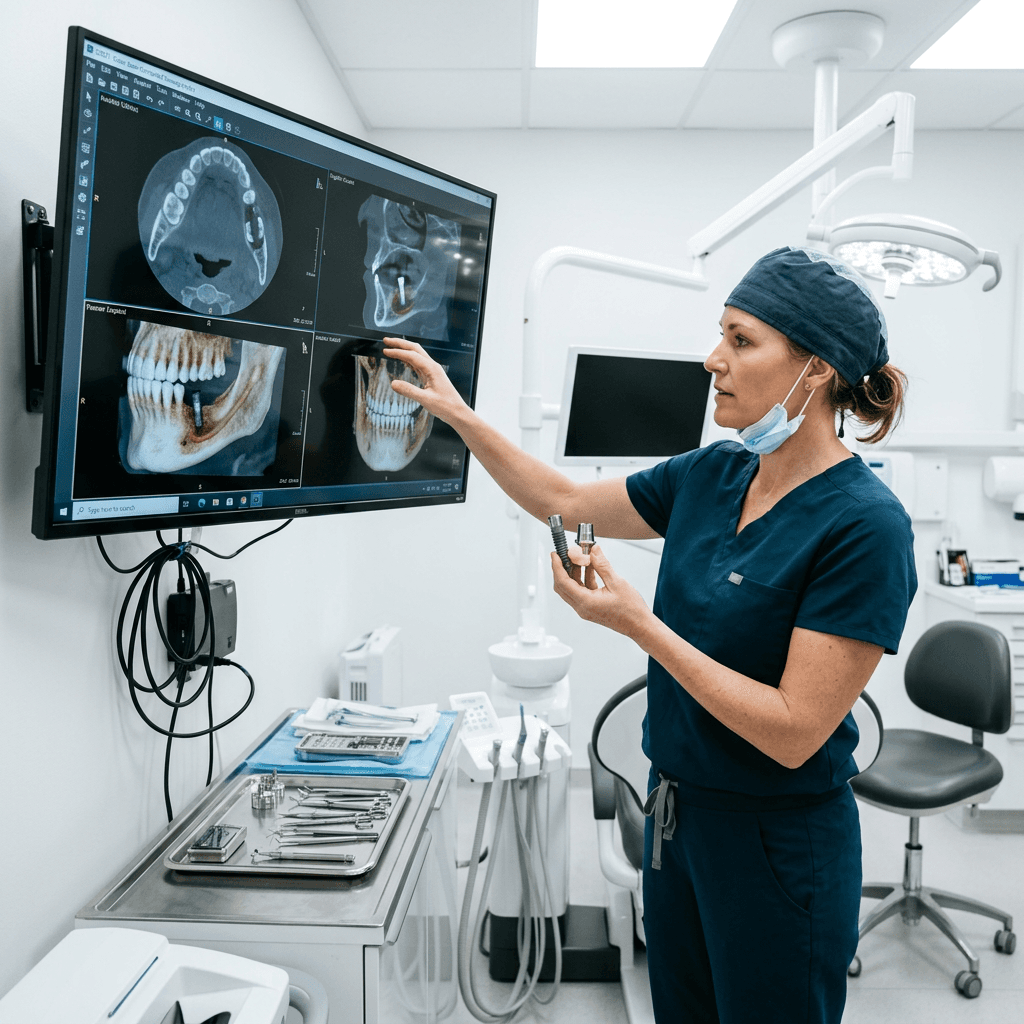
Two patients replacing the same tooth can pay meaningfully different amounts. The honest drivers are anatomical, and a 3D scan reveals them before you commit:
- — Bone grafting: if the jawbone has thinned since the tooth was lost, a graft ($300–$3,000 per site) rebuilds the foundation. Waiting longer to treat usually means more grafting, not less.
- — Tooth extraction: if the failing tooth is still present, removal adds a surgical step — though combining extraction and implant placement in one visit can reduce total cost.
- — Front-tooth aesthetics: implants in the smile zone demand more precise gum contouring and crown artistry than molars.
- — Material choice: zirconia posts and premium ceramic crowns carry a modest premium over standard titanium-and-porcelain systems.
- — Sedation: IV sedation adds a fee that many self-pay patients consider well worth it — and it should appear in the written quote, not as a day-of surprise.
Implant vs. Bridge: The 20-Year Self-Pay Math
A three-unit bridge usually quotes lower than an implant, which makes it tempting when every dollar is your own. But a bridge requires grinding down two healthy neighboring teeth and typically needs replacement every 10–15 years — so over twenty years, the “cheaper” option is often purchased twice while the implant is purchased once. It also does nothing to stop the jawbone under the gap from resorbing. Our full implant vs. bridge cost comparison runs the complete numbers.
The same time-value logic applies to waiting. The National Institute of Dental and Craniofacial Research's overview of dental implant care notes that implants depend on adequate healthy bone — and bone under a missing tooth shrinks steadily without root stimulation. Delaying a $4,000 implant by a few years can turn it into a $6,000+ graft-plus-implant case.
How to Afford an Implant Without Insurance
Self-pay does not mean paying it all on surgery day. Third-party healthcare lenders like CareCredit and Proceed Finance split the cost into monthly payments, and many plans carry 0% APR promotional periods of 6–24 months — pay the balance inside the window and the financing costs nothing. If you have an HSA or FSA, implant treatment is typically an eligible expense, letting you pay with pre-tax dollars. Our guide to dental implant financing options walks through the strategies in order of savings.
Dr. Antipov's Roseville office quotes one all-inclusive written case fee after your 3D scan — surgery, hardware, crown, imaging, and follow-ups — backed by a price-match guarantee for comparable written treatment plans from board-certified specialists in the region. Dr. Antipov reviews your 3D imaging personally, so the plan — and its price — reflects your actual anatomy rather than a generic estimate, and every included item is spelled out in writing before you commit.
Five Questions That Expose Hidden Fees
Take these to every consultation — a transparent provider answers all five without hesitation:
- — Is the final custom crown included in this quote, or billed separately by a restorative dentist?
- — Is the abutment included, or is it a separate line item?
- — Are 3D CBCT imaging and all follow-up visits covered in the case fee?
- — What happens financially if the implant fails to integrate — is replacement covered?
- — Is sedation included, and at what level?
Frequently Asked Questions
How much does a single tooth implant cost without insurance in 2026?
In the Roseville and greater Sacramento area, a complete restoration — implant post, abutment, and custom crown — typically costs $4,000 to $6,000 from a board-certified specialist. Quotes far below that range usually cover only the surgical post, with the abutment and crown billed separately later.
Does a single tooth implant quote include the crown?
Not always — and that is the most common source of surprise bills. Some offices advertise a price covering only surgical placement of the post. Insist on a total case fee that lists the post, abutment, and final custom crown in writing before you commit.
How much does a bone graft cost out of pocket?
Typically $300 to $3,000 per site in 2026, depending on the grafting material and the extent of bone loss. A 3D CBCT scan at your consultation determines whether you need one — many patients who assume they need grafting turn out to have adequate bone.
Can I pay for a dental implant in monthly installments?
Yes. Healthcare lenders like CareCredit and Proceed Finance offer terms that turn the cost into a predictable monthly payment, often with 0% APR promotional periods of 6–24 months. HSA and FSA funds can also typically be applied, effectively paying with pre-tax dollars.
Is it cheaper to get a bridge instead of an implant?
Up front, usually yes — over twenty years, usually no. A bridge requires grinding down two healthy neighboring teeth and typically needs replacing every 10–15 years, so it is often purchased twice in the time one implant lasts, while doing nothing to prevent bone loss under the gap.
What happens if I wait to replace a missing tooth?
The jawbone under the gap resorbs steadily without stimulation from a root, and neighboring teeth drift into the space. Waiting a few years can convert a straightforward implant into a graft-plus-implant case costing significantly more — delay is the most expensive variable in implant pricing.
Do self-pay patients get discounts on dental implants?
Many practices offer transparent all-inclusive pricing to direct-pay patients because eliminating insurance administration reduces overhead. The bigger protection is structural: a single written case fee from one office handling both surgery and crown removes the fragmented billing where hidden fees live.
Are there hidden fees in dental implant surgery?
Hidden fees usually come from fragmented quoting — imaging, sedation, the abutment, or follow-up visits billed separately from the advertised price. Request a comprehensive written treatment plan that itemizes every step from the 3D CBCT scan to final crown placement; a transparent provider supplies one readily.
Get One Honest Number — In Writing
Schedule a free implant consultation with Dr. Antipov in Roseville — you'll get 3D CBCT imaging, a clear answer on whether you need grafting, and one all-inclusive written case fee backed by a price-match guarantee. Restrictions apply.
Book a Free Consultation