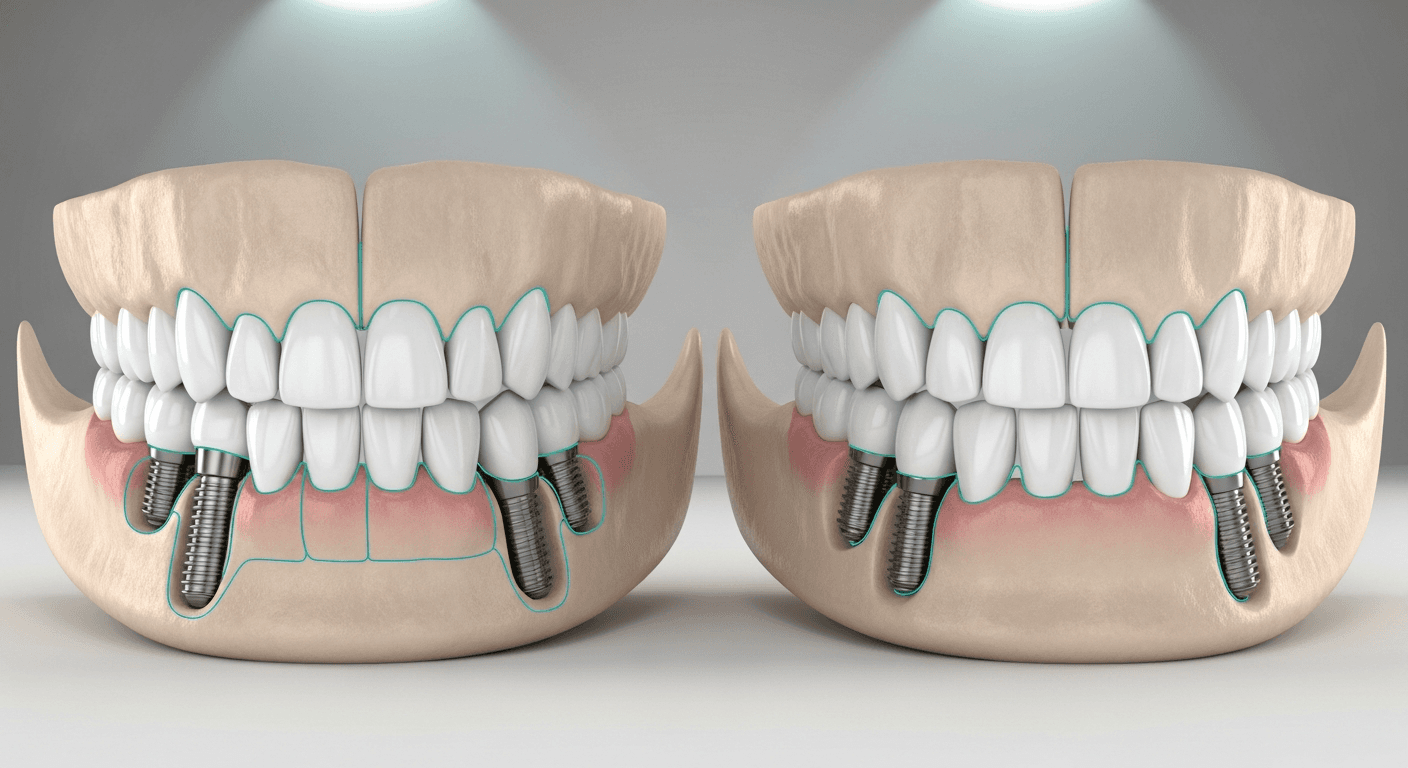
Dental Bridge vs. Implant: Which Fits Your Tooth and Your Timeline?
By Dr. Antipov Practice Editorial Team. Clinical review pending; this article has not yet been medically reviewed by Dr. Alexander V. Antipov, DDS.
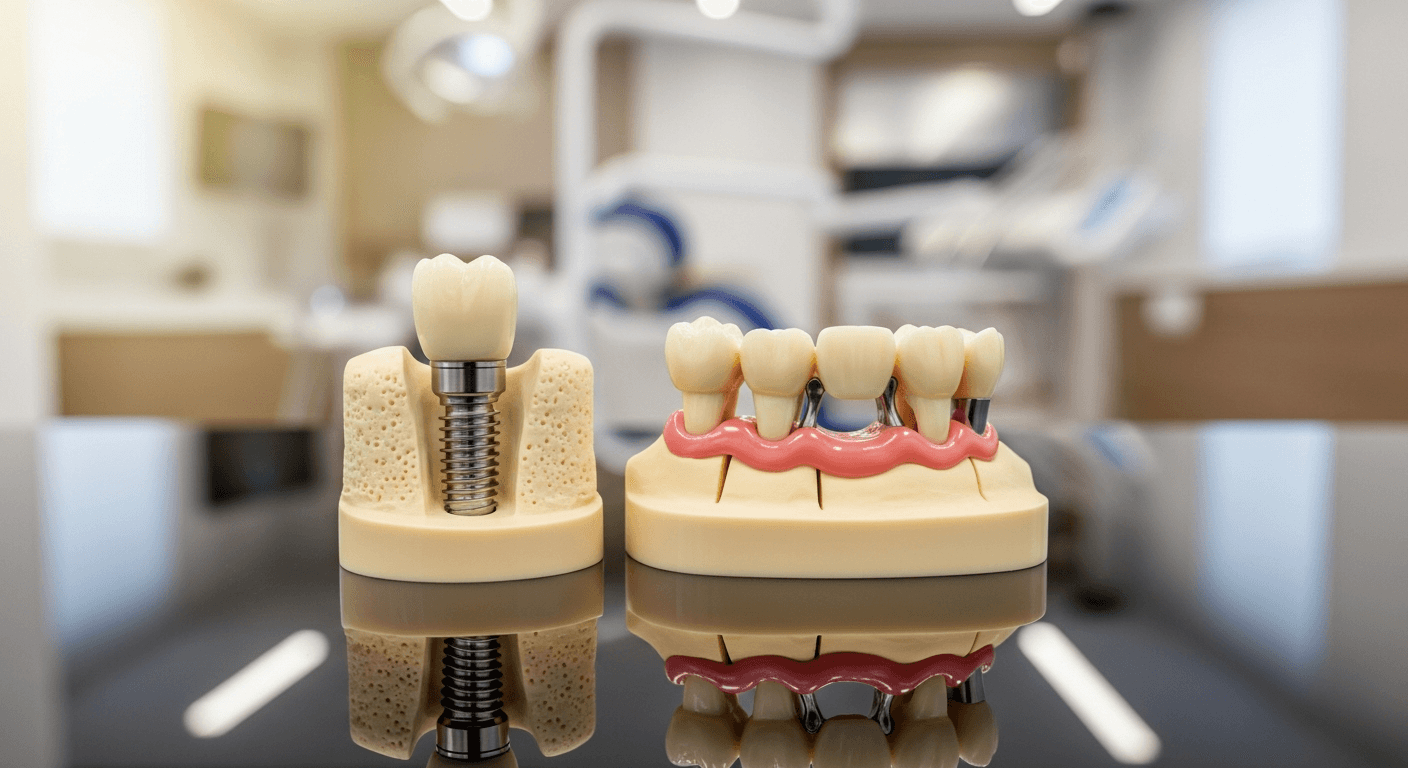
A bridge may be the better fit if the neighboring teeth already need crowns or you prefer to avoid implant surgery; an implant may make more sense if those teeth are sound and the bone can support it. Dr. Alexander Antipov, a board-certified oral and maxillofacial surgeon in Roseville, evaluates the implant side of this decision in the context of the final restoration rather than treating every missing tooth as an automatic indication for surgery.
This comparison is educational, not a personal treatment recommendation. A dentist must assess the teeth bordering the gap, gum health, bite, imaging and medical factors before either option is selected.
One missing tooth, two very different kinds of support
A conventional three-unit bridge uses crowns on the teeth on either side of the missing tooth, connected to an artificial tooth called a pontic. An implant-supported crown instead connects to an implant placed in the bone at the missing-tooth site. Both can fill a visible gap and restore a chewing surface, but each asks something different of the mouth.
The American Dental Association's MouthHealthy bridge overview describes fixed bridges and their need for supporting teeth. Its implant overview explains that implants support replacement teeth in the jaw. These are distinct restorative designs, not simply different materials for the same procedure.
| Decision point | Tooth-supported bridge | Single implant and crown |
|---|---|---|
| Neighboring teeth | Usually requires preparing the teeth bordering the gap; can also restore them if they already need crowns. | Usually leaves neighboring tooth structure untouched; needs a suitable implant site. |
| Treatment path | No implant surgery; laboratory fabrication and fitting commonly take multiple appointments. | Surgical placement and healing precede or accompany restoration; grafting may add a stage. |
| Bone at missing site | Pontic sits above the ridge and does not replace a root. | Implant occupies a planned position in bone; ridge contour still needs evaluation. |
| Daily cleaning | Requires cleaning under the connected pontic, often with threaders or interdental tools. | Requires cleaning around the crown and implant gumline; not maintenance-free. |
| Future repair | Decay or fracture of a supporting tooth may affect the whole connected unit. | Implant, abutment and crown have different failure modes; a crown may be repairable or replaceable. |
| Upfront fees | Often avoids surgery but includes several restorative units. | May include imaging, surgery, grafting if needed, an abutment and the final crown. |
First ask what the adjacent teeth actually need
If both bordering teeth have extensive fillings, old crowns or fractures and would benefit from new crowns anyway, a bridge can solve more than one problem at once. If they are intact, creating space for bridge retainers removes tooth structure that cannot be put back. That does not automatically make a bridge wrong, but it changes the trade-off.
A bridge depends on those neighboring roots. A dentist should check their periodontal support, root-canal history, decay risk and ability to bear the new load. An implant avoids using them as anchors, but its own position has to work with their roots and with the crown shape. Neither option rescues a poor bite design simply by being called permanent.
If you already have an aging bridge, our article on replacing old failing bridges explains why its supporting teeth deserve an examination before anyone assumes implants will replace the entire unit.
What the bone can and cannot tell you
The jaw ridge often changes shape after tooth extraction. An implant requires adequate space between adjacent roots, adequate bone around its proposed position and a safe relationship to nerves or the maxillary sinus. Some sites are suitable without preparation; others may need a graft, a different implant plan or a different restoration. A bridge can sometimes avoid that surgical complexity, particularly when the patient does not want additional procedures.
It is too strong to say that an implant stops all jawbone loss. Bone can still remodel around implants, and gums can change. An implant can help maintain bone at its own site by carrying function; it does not automatically protect every part of the ridge or prevent age-related facial changes. A bridge's pontic does not replace the missing root, but an appropriately designed bridge remains a legitimate restorative option.
For a closer look at site preparation, see when bone grafting is considered. If the missing tooth is in the front, gum shape and the symmetry of the smile may influence planning as much as available bone width.
The timeline is more than the surgery date
A traditional bridge generally avoids a bone-integration period. The dentist prepares the supporting teeth, provides a temporary if appropriate, and fits the final bridge after it has been made. Individual schedules vary, particularly when gum treatment or root-canal care is needed first. Implants usually involve evaluation and surgical placement, a healing interval, and a custom abutment and crown. Extraction and grafting may be separate stages.
Immediate placement means an implant is inserted when the tooth is removed. Immediate loading means a temporary restoration is attached promptly. These are not synonyms, and neither means the final tooth is finished that day. The condition of the socket, implant stability, bite and appearance determine what is safe. If an event is coming up soon, tell your team: a temporary tooth can sometimes maintain appearance while a longer-term plan proceeds.
Our single-tooth implant process guide explains the separate roles of placement, healing and final crown delivery.
Compare ownership costs, not slogans about longevity
A bridge's fee includes the connected restoration, but future work on a supporting tooth could mean repairing or replacing that unit. An implant estimate may be split between the surgeon and restorative dentist and may not include extraction, graft, temporary tooth or final crown. Neither design is guaranteed to last a lifetime. Bridges can function for many years with good supporting teeth; implants can need crown or screw repairs and can develop complications around the gumline.
Ask for written, itemized plans showing the complete sequence, who supplies the temporary and final tooth, and what maintenance visits are expected. Insurance policies may handle bridge units and implant components differently. A quoted surgery-only number cannot be compared fairly with a completed bridge price. If money or time makes one route impractical now, discuss a safe interim option rather than accepting irreversible treatment without understanding the alternatives.
The FDA's patient guide to dental implants notes possible surgical and long-term risks; it is a useful counterweight to claims that an implant is a one-time, maintenance-free purchase.
A short decision exercise for a Roseville consultation
Write down which tooth is missing, how long it has been absent and whether the adjacent teeth already have crowns. Ask your restoring dentist for the prognosis of those neighbors if you do nothing to them. Ask whether you have room and bone for a crown in the desired position, and what changes if grafting is necessary. If you have gum disease, get it assessed before committing to either restoration.
Bring two written scenarios to the appointment: the complete bridge and the complete implant-plus-crown. For each, ask how long until you can chew on the finished tooth, what happens if a supporting component fails, how you will clean it and who will perform follow-up. If those answers remain uncertain after the exam, seek clarification. The right choice is one you can maintain, not simply the one with the most persuasive headline.
Frequently Asked Questions
Is a bridge always faster than an implant?
Often it avoids the surgical healing interval, but gum treatment, root canals, laboratory work or complex tooth preparation can change the schedule. Request timelines for your own case.
Do bridges always damage healthy teeth?
Conventional bridges require preparing supporting teeth. This is an important cost when those teeth are intact, but can be reasonable when they already need extensive crowns.
Can I replace an old bridge with just one implant?
Possibly, but removing the bridge may reveal problems with one or both anchor teeth. The number of missing teeth and the condition of the supports determine the new plan.
Does an implant make the neighboring teeth stronger?
It replaces support at the gap rather than strengthening adjacent teeth directly. Their individual health and bite still need attention.
Will a bridge or implant look more natural in a front-tooth gap?
Either can look convincing. Gum contour, bone, tooth color, the condition of neighboring teeth and the design of the temporary and final restoration influence the result.
What if I do not have enough bone for an implant?
Imaging can clarify whether grafting or a changed implant position is feasible. A bridge or another tooth-replacement option may be preferable if surgery does not fit your goals.
Which is cheaper over time?
There is no universal winner. Upfront fees, condition of bridge supports, possible grafting, repair needs and insurance all matter. Compare completed plans rather than surgery-only and bridge-only prices.
Compare plans for your actual tooth
Bring your dentist's restorative proposal to a Roseville implant evaluation with Dr. Antipov. A coordinated plan can clarify whether an implant makes sense without dismissing a well-designed bridge. Restrictions apply.
Book a Free Dental Implant Consultation