The Single Tooth Implant Process: From 3D Consultation to Final Crown
Medically reviewed by Dr. Alexander V. Antipov, DDS — Board-Certified Oral & Maxillofacial Surgeon · Diplomate, American Board of Oral & Maxillofacial Surgery (ABOMS) · California Dental License #50724
The single tooth implant process typically unfolds in four stages — a 3D imaging consultation, surgical placement of a titanium post, a healing period of several months while the bone fuses to it, and delivery of a custom crown — and the full journey commonly takes three to six months, explains Dr. Alexander Antipov, a board-certified oral and maxillofacial surgeon in Roseville, CA. The surgical appointments themselves are short; it is the quiet biological work between them, called osseointegration, that sets the pace. This guide walks through each stage in order — what actually happens, how long it takes, and the decisions you will be asked to make along the way — so that nothing about the process surprises you. If you are still weighing whether an implant is the right choice at all, start with our complete single tooth implant guide and the honest implant vs. bridge cost comparison.
This article is for general education and is not a substitute for a clinical exam. Timelines, candidacy, and costs vary with your anatomy, bone density, and overall health — your specific plan is determined after 3D imaging at an in-person consultation.
The Four Stages at a Glance
Most single tooth implants follow a similar arc, though the timing and steps flex with your biology and the specifics of your site. Here is the roadmap most straightforward cases follow:
| Stage | What happens | Typical timing |
|---|---|---|
| 1. 3D consultation | CBCT scan maps bone, nerves, and sinuses; candidacy and plan are set | 1 visit |
| 2. Implant placement | Titanium post placed with computer guidance; local anesthesia or sedation | 1 visit, often under an hour |
| 3. Osseointegration | Jawbone fuses to the post — the foundation-building phase | Commonly 2–6 months |
| 4. Abutment & crown | Connector and custom crown attached; bite fine-tuned | 1–2 visits |
Why a Missing Tooth Is a Structural Problem, Not Just a Cosmetic One
The moment a tooth is lost, the jawbone beneath it starts losing the stimulation it needs to maintain density, and the body begins reabsorbing that bone. Neighboring teeth can drift or tilt into the gap, changing your bite and putting uneven wear on enamel. Waiting years to address a gap can shrink the very foundation an implant needs — which is why some delayed cases end up requiring bone grafting first.
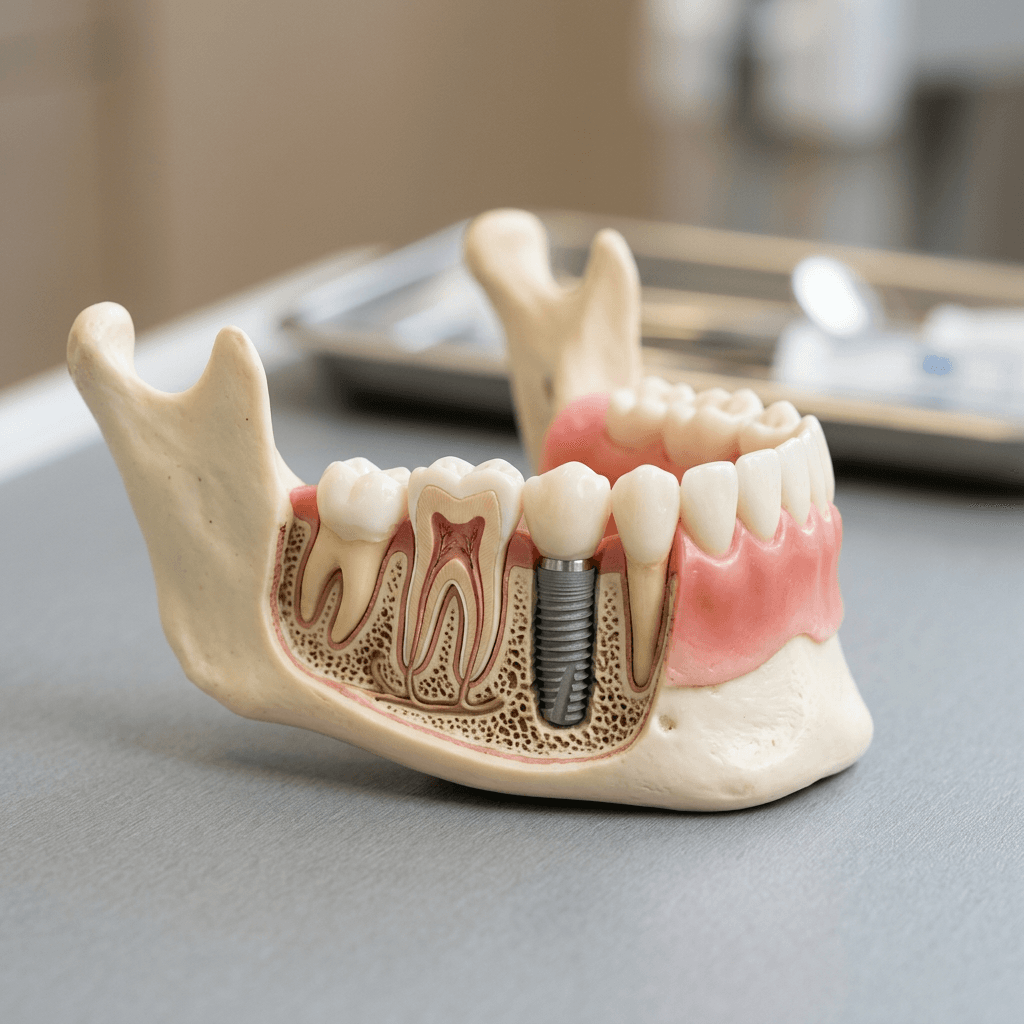
An implant is the tooth replacement designed to address the root problem — literally. Because the titanium post functions as an artificial root, chewing forces once again stimulate the bone around it. The National Library of Medicine's overview of dental implants describes how the post is placed into the jawbone and the bone grows around it to hold it in place. A bridge, by contrast, only spans the gap — and requires grinding down the healthy teeth on either side to serve as anchors.
Stage 1: The 3D Consultation — Where the Whole Case Is Decided
Modern implant surgery is planned before it is performed. A cone-beam CT (CBCT) scan builds a three-dimensional map of your jaw: exact bone height and width, the position of nerves, and the location of your sinuses. From that map, the surgical plan — implant size, angle, and depth — is set digitally, which typically helps keep the placement appointment short and predictable.
This is also the visit where the practical questions get answered: whether your bone can support an implant now or needs grafting first, whether titanium or zirconia makes more sense for your site, what sedation options fit your comfort level, and what your written cost estimate looks like. You can read more about how digital planning improves accuracy in our guide to computer-guided implant surgery.
Bring a list of current medications and any prior dental records or X-rays you have — they help complete the clinical picture and can occasionally spare you repeat imaging.
Titanium vs. Zirconia: Choosing the Post Material
Most patients receive a medical-grade titanium post — it has the longest track record, decades of research behind its biocompatibility, and remains the standard for high-load molar sites. Zirconia, a strong ceramic, is a metal-free alternative some patients prefer for front teeth or when thin gum tissue might otherwise let a dark metal hue show through near the gum line.
Neither material is universally better; the right call depends on the tooth's position, your gum thickness, any metal sensitivities, and how much biting force the site must carry. This is a decision your surgeon walks through with you at the consultation, with the trade-offs laid out for your specific site.
Stage 2: Placement Day — Shorter Than Most Patients Expect
On surgery day, the digital plan from your consultation guides the placement of the post at the pre-determined angle and depth. Because much of the planning work is done in advance, a straightforward single-implant placement often takes less than an hour, under local anesthesia with sedation available for patients who want it.
Many patients report the procedure feels less eventful than a tooth extraction. Post-operative soreness is typically mild and manageable with over-the-counter medication, and most people return to normal daily routines within a day or two. Plan on soft foods — yogurt, eggs, smoothies, mashed potatoes — for the first stretch, and keep pressure off the surgical site while the soft tissue closes.
Stage 3: Osseointegration — The Months That Do the Real Work
After placement comes the least dramatic and most important stage: osseointegration, where your jawbone grows onto and bonds with the post's surface. This is what turns a screw into a root. It cannot be rushed — the timeline is set by your biology, commonly running two to six months depending on bone quality and location (lower jaws often integrate faster than upper).
During this phase you will live mostly normally. Depending on the site, a temporary tooth can often cover the gap so you are not walking around with a visible space. Your surgeon confirms integration is complete — typically with imaging and stability checks — before any permanent crown is attached, because loading the post too early is one of the avoidable causes of implant failure.
Stage 4: Abutment and Crown — The Finish Line
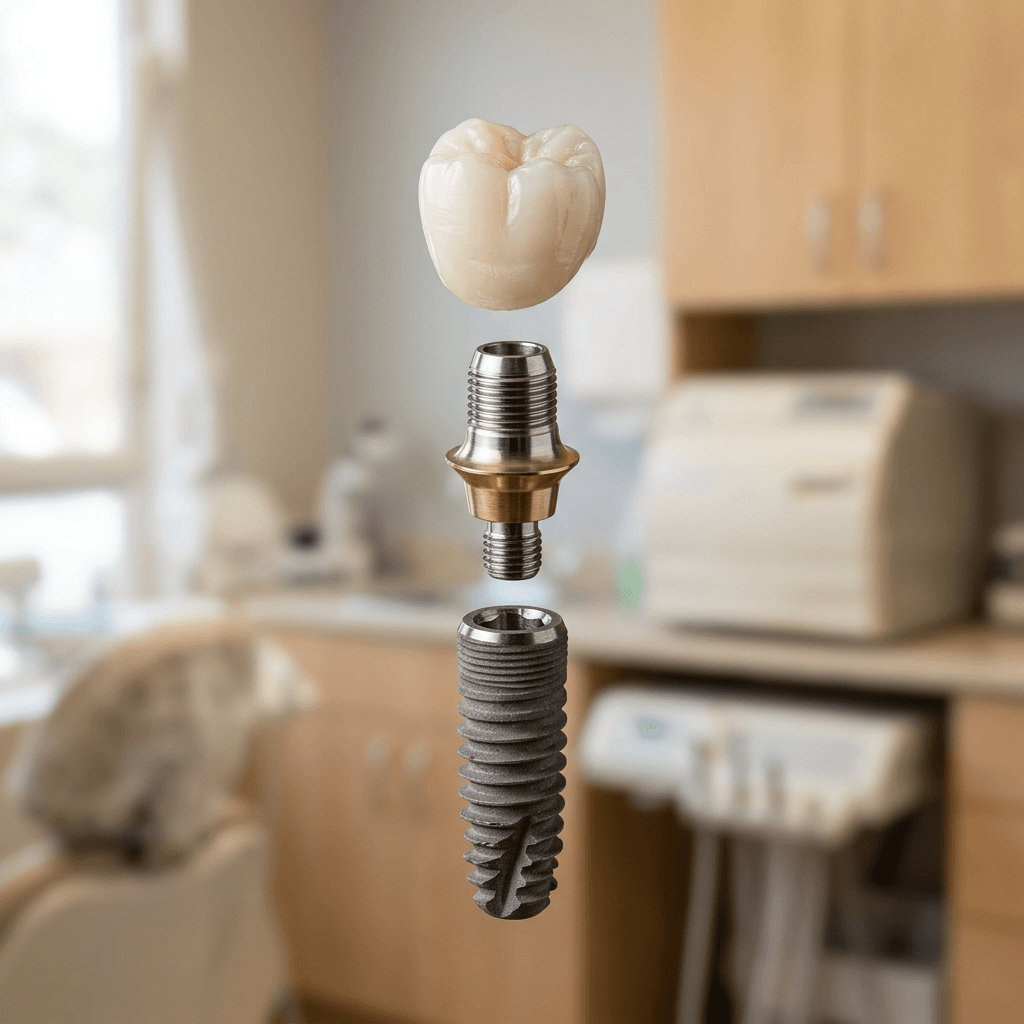
Once the foundation is confirmed solid, a connector called an abutment is attached to the post, and impressions or digital scans are taken for your custom crown. The crown is crafted to match the shade, translucency, and contour of your neighboring teeth, then secured and fine-tuned so your bite feels natural.
From this point on, the implant is cared for like a natural tooth: brushing twice daily, flossing, and regular professional cleanings. The crown cannot get a cavity, but the gum and bone around it still need the same maintenance your natural teeth do.
What a Single Tooth Implant Costs in the Roseville Area
At our Roseville practice — which also welcomes patients traveling in from Sacramento and surrounding communities — a complete single tooth implant (post, abutment, and crown together) commonly runs $4,000–$6,000, with the final figure depending on whether grafting is needed and which materials are chosen. Some dental plans contribute toward parts of treatment, and monthly financing can spread the investment out — our dental implant payment plans guide covers the options in detail.
Be cautious comparing quotes: a low advertised price sometimes covers only the post, with the abutment and crown billed separately. Ask any provider whether a quote is all-inclusive before comparing numbers.
Why Surgeon Training Matters for a “Routine” Implant
Single implants are often described as routine, but they sit millimeters from nerves and sinuses, and careful planning and placement are among the biggest factors influencing long-term stability. Board-certified oral and maxillofacial surgeons complete years of hospital-based surgical residency beyond dental school, which matters most when a case turns out to be less simple than it looked — thin bone, a sinus in the way, or a failing adjacent tooth. Learn more about single tooth implant treatment at our Roseville practice.
Frequently Asked Questions
How long does the whole single tooth implant process take?
Most straightforward cases run three to six months from consultation to final crown. The surgical appointments are short — placement often takes under an hour — but the osseointegration phase, where bone fuses to the post, commonly needs two to six months and cannot safely be rushed.
Is getting a single tooth implant painful?
The placement is done under local anesthesia, with sedation available, and many patients report it feels less eventful than an extraction. Post-operative soreness is typically mild, manageable with over-the-counter medication, and most people are back to normal routines within a day or two.
Will I have a gap in my smile while the implant heals?
Usually not. Depending on the site, a temporary tooth — such as a removable flipper or a bonded temporary — can cover the gap during the healing months. Your surgeon will recommend the option that protects the surgical site while keeping your smile intact.
How long does a single tooth implant last?
The titanium post is designed to be a long-term, often permanent fixture once it integrates with the bone, and well-maintained implants commonly last for decades. The crown on top experiences normal wear like any tooth and may need replacement or maintenance over time.
What is the success rate for single tooth implants?
Published success rates for dental implants in healthy patients are commonly cited above 95%. Careful 3D planning, precise placement, not smoking, and good home care are the biggest factors you and your surgical team can control.
Can I get an implant if I've already lost bone in my jaw?
Often, yes. Bone grafting procedures can rebuild lost height and width so the site can support a post — it adds time to the process but keeps the permanent option on the table. A CBCT scan at the consultation shows exactly how much bone you have and whether grafting is needed.
Titanium or zirconia — which implant material is better?
Titanium is the long-standing standard with the deepest research record, especially for molars that take heavy biting force. Zirconia is a metal-free ceramic alternative some patients prefer for front teeth or thin gum tissue. The right choice depends on the tooth's position and your anatomy — it's a site-by-site decision, not a ranking.
How do I care for the implant after the crown is placed?
Treat it like a natural tooth: brush twice daily, floss around it, and keep up regular professional cleanings. The crown can't develop cavities, but the gum and bone supporting the implant still depend on good hygiene to stay healthy long-term.
Start With a Free 3D Implant Consultation in Roseville
Schedule a free implant consultation with Dr. Antipov in Roseville — 3D CBCT imaging, a clear answer on whether an implant is right for your site, and one transparent written plan covering every stage from placement to final crown. Restrictions apply.
Book a Free Consultation