Dental Implants for Missing Back Teeth: Restoring Your Bite and Oral Health
Medically reviewed by Dr. Alexander V. Antipov, DDS — Board-Certified Oral & Maxillofacial Surgeon · Diplomate, American Board of Oral & Maxillofacial Surgery (ABOMS) · California Dental License #50724
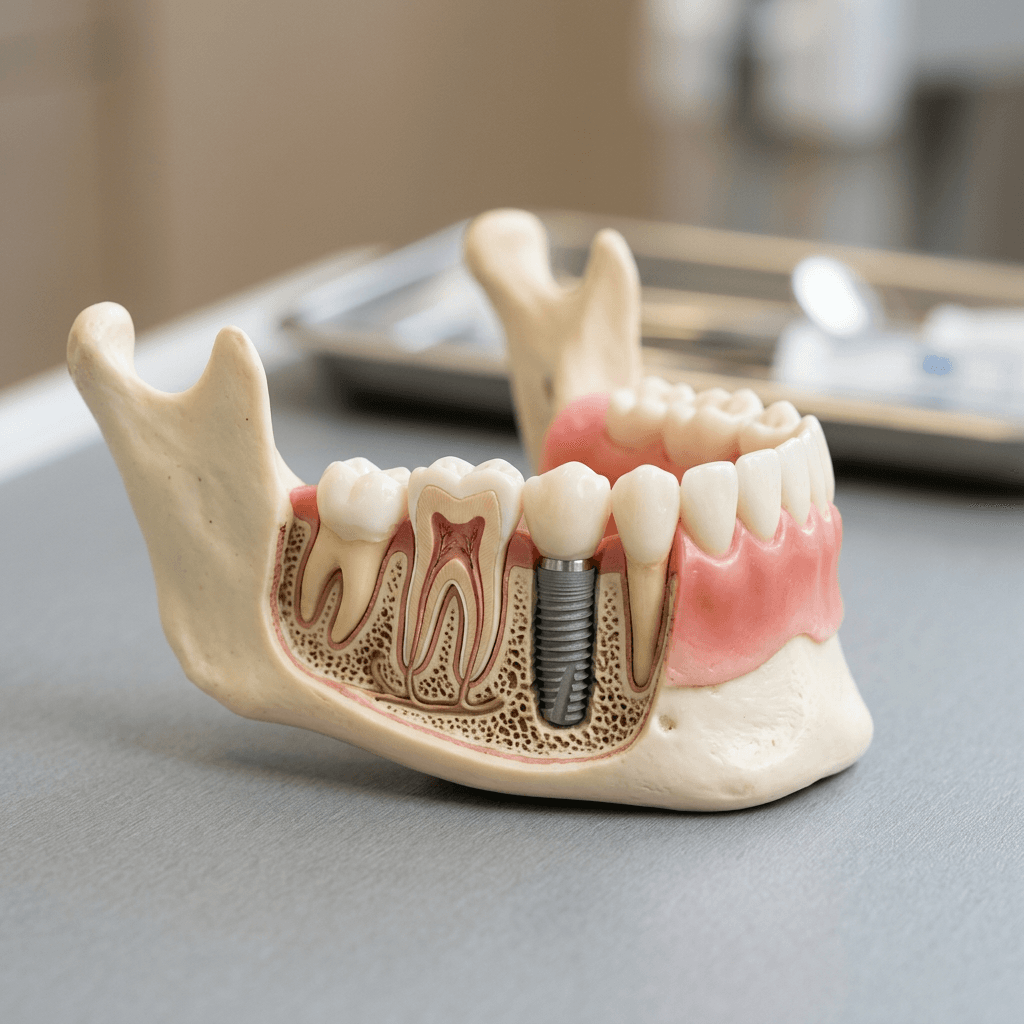
Replacing a missing back tooth with a dental implant is usually a functional necessity rather than a cosmetic choice — molars and premolars carry the heaviest chewing loads, hold your bite's vertical dimension, and keep neighboring teeth from drifting, explains Dr. Alexander Antipov, a board-certified oral and maxillofacial surgeon in Roseville, CA. Because the gap is out of sight, many patients wait years, and that delay is exactly when the quiet damage happens: bone resorption at the empty site, tilting neighbors, and supra-eruption of the opposing tooth. This guide covers what a missing molar actually sets in motion, how implants compare with bridges and partials in the back of the mouth, the engineering behind molar implants, and what the process looks like from 3D scan to final crown. If your tooth was recently removed, start with our guide to implant timing after tooth extraction.
This article is for general education and is not a substitute for a clinical exam. Whether an implant, graft, or sinus lift is right for you depends on your anatomy, bone volume, and health history — your specific plan is determined after 3D imaging at an in-person consultation.
Back Tooth Replacement Options at a Glance
Three main paths exist for replacing a missing molar or premolar, and they differ most in what they do for the bone underneath:
| Dental implant | Traditional bridge | Removable partial | |
|---|---|---|---|
| Replaces the root | Yes — titanium post in the bone | No — spans the gap | No — rests on gums |
| Impact on neighbors | None — standalone unit | Healthy enamel ground down on both anchors | Metal clasps stress remaining teeth |
| Bone preservation | Stimulates bone at the site | Bone continues to resorb under the gap | Bone continues to resorb |
| Typical lifespan | Designed to last decades with good care | Commonly replaced every 7–10 years | Adjusted or remade as the jaw changes |
| Hygiene | Brush and floss like a natural tooth | Requires threaders under the span | Removed nightly for cleaning |
The Hidden Cost of Ignoring a Missing Molar
Back teeth do more than chew. They maintain the vertical dimension of your face — the working distance between nose and chin — and they share bite forces so your front teeth, which are built for cutting rather than grinding, are not overloaded. When molars are missing, front teeth commonly take on strain they were never designed for, which over time shows up as chipping, wear, and mobility.
The mouth is also a balanced system that starts shifting the moment a tooth leaves it. Neighboring teeth tilt and drift into the space; the opposing tooth can supra-erupt — slowly moving out of its socket because nothing bites against it. And beneath the gum, bone resorption begins within the first year, because jawbone keeps its density only when tooth roots stimulate it. The National Library of Medicine's overview of dental implants describes how a titanium post placed in the jaw acts as a replacement root, restoring that stimulation at the site.
Shifted, hard-to-clean teeth also raise the risk of decay and gum disease, and an unbalanced bite can contribute to jaw-joint discomfort and tension headaches in some patients. The longer the gap stands, the more likely the eventual fix requires grafting first.
Implants vs. Bridges in the Back of the Mouth
A bridge can feel like the simpler path, but in the molar region it carries real trade-offs. Placing one requires grinding down the healthy teeth on either side of the gap to serve as anchors — sacrificing sound enamel to fix one missing tooth — and the back of the mouth is exactly where chewing forces are highest, which is why bridges there commonly need replacement every 7–10 years. An implant is a standalone unit: nothing is done to the neighbors, and you floss it like a natural tooth. Our implant vs. bridge cost comparison runs the long-term numbers side by side.
Removable partials are the third option, and for back teeth they tend to be the most frustrating: clasps that stress the remaining teeth, movement during firm chewing, and no bone stimulation at all. They have a legitimate role as an interim or budget solution, but they do not address the underlying structural problem.
The Engineering of a Molar Implant: Built for Heavy Loads
Replacing a front tooth is largely an aesthetic exercise; replacing a molar is a structural one. Chewing forces in the molar region are the highest in the mouth — commonly cited at up to around 200 pounds per square inch — so surgeons approach these sites differently. Wider-diameter implants are often selected to spread force across more bone and resist the micro-movement that can compromise integration, and the post's angle is planned digitally against the opposing tooth so the final crown loads straight down its axis rather than rocking sideways.
The crown itself is made from high-strength materials — typically monolithic zirconia or porcelain engineered for posterior wear — chosen for durability over show. You can read more about how digital planning improves placement accuracy in our guide to computer-guided implant surgery.
Sinus Lifts and Bone Grafting: When Back Teeth Need Extra Steps
Bone conditions differ sharply between jaws. The lower jaw is typically dense and supportive; the upper back jaw is softer and sits directly beneath the sinus cavities. When an upper molar has been missing for a while, there is often not enough bone height between the ridge and the sinus floor — in those cases a sinus lift gently raises the sinus membrane and places graft material beneath it, creating room for a stable implant.
For sites with lost width or height in either jaw, bone grafting with biocompatible materials encourages your own bone to regenerate. These procedures add time to the overall treatment, but they are routine in oral surgery practice and are frequently what makes an implant possible for patients who were told years ago that they were not candidates. A CBCT scan shows precisely how much bone you have and whether any of this applies to you.
What to Expect: The Molar Implant Journey in Roseville
The process follows the same staged arc as any single implant: a 3D CBCT consultation where bone volume, nerve position, and sinus anatomy are mapped and the plan is set digitally; a placement visit — often under an hour, with local anesthesia or IV sedation; a healing period of roughly 2–6 months while the bone fuses to the post; and finally the abutment and custom crown. In select cases with strong, stable bone, a temporary restoration can sometimes be attached sooner — candidacy for that is determined at the consultation, not promised in advance. Our step-by-step single tooth implant process and timeline guide walks through each stage in detail.
Recovery from a straightforward placement is typically brief — most patients are back to normal routines within a day or two, with soreness managed by over-the-counter medication and a soft-food stretch while the site heals.
What a Back Tooth Implant Costs in the Roseville Area
At our Roseville practice — which welcomes patients traveling in from Sacramento, Rocklin, El Dorado Hills, and surrounding communities — a complete single tooth implant (post, abutment, and crown) commonly runs $4,000–$6,000, with sinus lifts or grafting adding to the total when needed. Many dental plans now contribute toward parts of implant treatment, and monthly financing can spread the investment out — our dental implant payment plans guide covers the options.
It is also worth framing the cost over time: a bridge that needs replacement every decade can exceed the cost of an implant over a lifetime, while doing nothing often leads to more complex — and more expensive — corrective work later. Ask any provider for an all-inclusive written quote before comparing numbers.
Why Surgical Training Matters for Back Teeth
Molar sites concentrate the tricky anatomy: the sinus floor above upper molars, the inferior alveolar nerve below lower ones, and the heaviest bite forces in the mouth. Board-certified oral and maxillofacial surgeons complete years of hospital-based surgical residency beyond dental school — training that matters most when a case involves grafting, sinus work, or bone that turns out thinner than the X-ray suggested. Learn more about single tooth implant treatment at our Roseville practice.
Frequently Asked Questions
Do I really need to replace a back tooth if nobody can see the gap?
In most cases, yes. Back teeth anchor your bite, protect your front teeth from overload, and keep the jawbone stimulated. Left unreplaced, neighboring teeth drift, the opposing tooth can supra-erupt, and bone at the site resorbs — changes that make later treatment more complex and more expensive.
How much does a back tooth implant cost in the Roseville area?
A complete single tooth implant — post, abutment, and crown together — commonly runs $4,000–$6,000 in the Roseville area. If a sinus lift or bone graft is needed first, that adds to the total. Ask for an all-inclusive written quote so you can compare providers fairly, and note that many dental plans contribute toward portions of treatment.
Does getting a molar implant hurt?
The placement is done under local anesthesia, with IV sedation available, and most patients describe pressure rather than pain. Afterward, soreness is typically mild, managed with over-the-counter or prescribed medication, and most people return to normal routines within a day or two.
How long is recovery for a back tooth implant?
The surgical site itself usually settles within days, but osseointegration — the bone fusing to the post — commonly takes 2–6 months before the permanent crown is attached. Lower-jaw sites often integrate faster than upper ones because the bone is denser.
Can I get an implant if my back tooth has been missing for years?
Often, yes. Years without a tooth usually mean some bone loss, but grafting and sinus-lift techniques can rebuild the support an implant needs. A CBCT scan shows exactly how much bone remains and whether regenerative steps are required before placement.
What if I don't have enough bone for a molar implant?
Insufficient bone rarely closes the door — it usually just adds a step. A bone graft can restore lost width or height, and for upper molars near the sinus, a sinus lift creates the vertical room an implant needs. These are routine procedures in an oral surgery practice, though they extend the overall timeline.
Will insurance cover a dental implant for a back tooth?
Many dental plans now offer partial coverage for implant-related procedures — commonly contributing $1,000–$3,000 depending on the policy — though coverage varies widely. It's worth having benefits verified up front so your out-of-pocket estimate is clear before treatment begins.
Why choose an oral surgeon rather than a general dentist for a molar implant?
Back-tooth sites involve the mouth's most demanding anatomy — sinus cavities above, nerves below, and the heaviest chewing forces. Board-certified oral and maxillofacial surgeons complete years of hospital-based surgical residency focused on exactly this work, which matters most when grafting, sinus lifts, or unexpected complexity enter the picture.
Find Out What's Happening Under That Gap
Schedule a free implant consultation with Dr. Antipov in Roseville — 3D CBCT imaging shows exactly how much bone you have, whether a graft or sinus lift is needed, and what a complete plan from placement to final crown looks like in one transparent written quote. Restrictions apply.
Book a Free Consultation