Fixed Dentures on Implants: The Complete Guide to Permanent Full-Arch Restoration
Medically reviewed by Dr. Alexander V. Antipov, DDS — Board-Certified Oral & Maxillofacial Surgeon · Diplomate, American Board of Oral & Maxillofacial Surgery (ABOMS) · California Dental License #50724
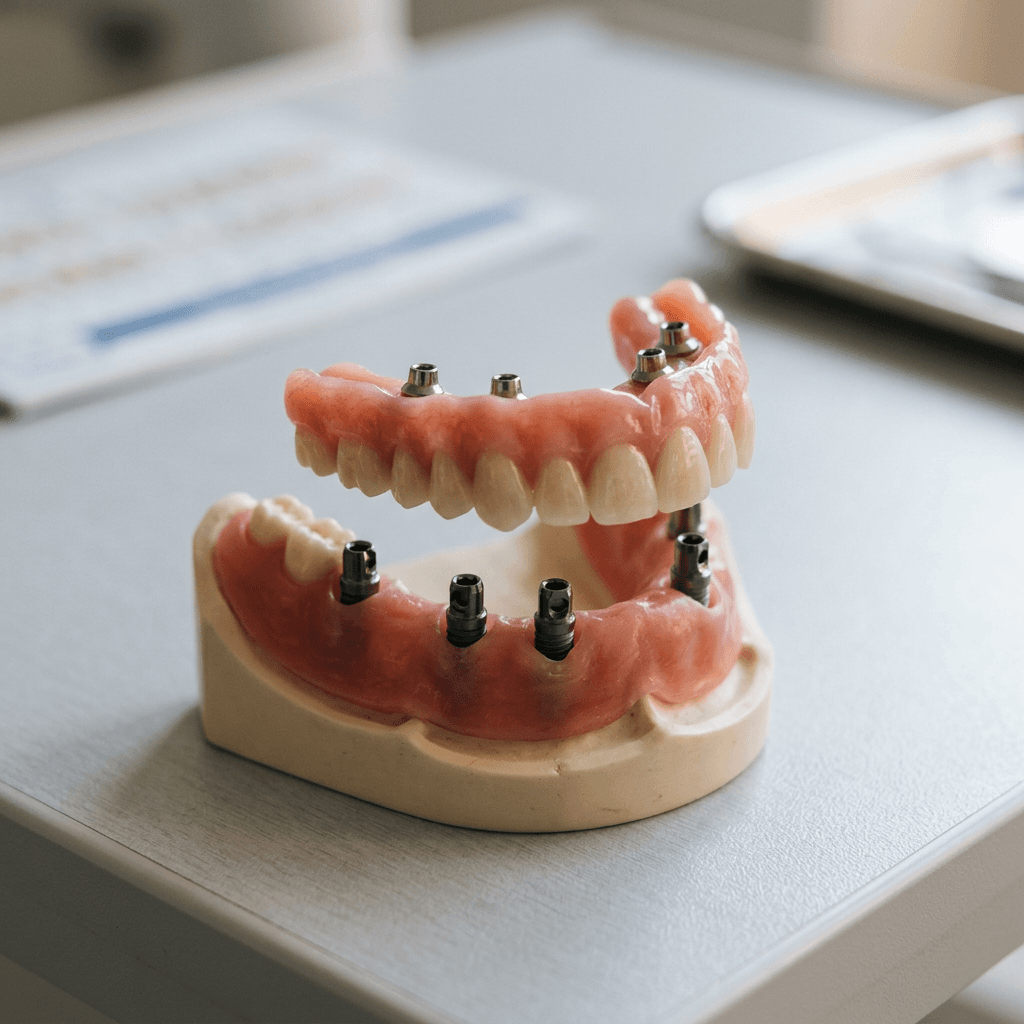
Fixed dentures on implants are a non-removable full-arch bridge anchored to 4–6 titanium posts placed in the jawbone — unlike a traditional denture, the restoration stays in 24/7, leaves the palate uncovered, and is cleaned like natural teeth, explains Dr. Alexander Antipov, a board-certified oral and maxillofacial surgeon in Roseville, CA. The difference is structural: a conventional denture rests on the gums and relies on suction or adhesive, while a fixed bridge transfers biting forces through implants directly into the bone, the way natural tooth roots do. This guide covers how that anchoring actually works, how fixed bridges compare with removable snap-in overdentures, what “same-day teeth” realistically means, and what the process and investment look like in 2026. If you are earlier in your research, our fixed vs. removable permanent dentures comparison is a good starting point.
This article is for general education and is not a substitute for a clinical exam. Candidacy, timelines, and costs depend on your bone volume, health history, and anatomy — your specific plan is determined after 3D imaging at an in-person consultation.
Fixed Implant Dentures vs. the Alternatives at a Glance
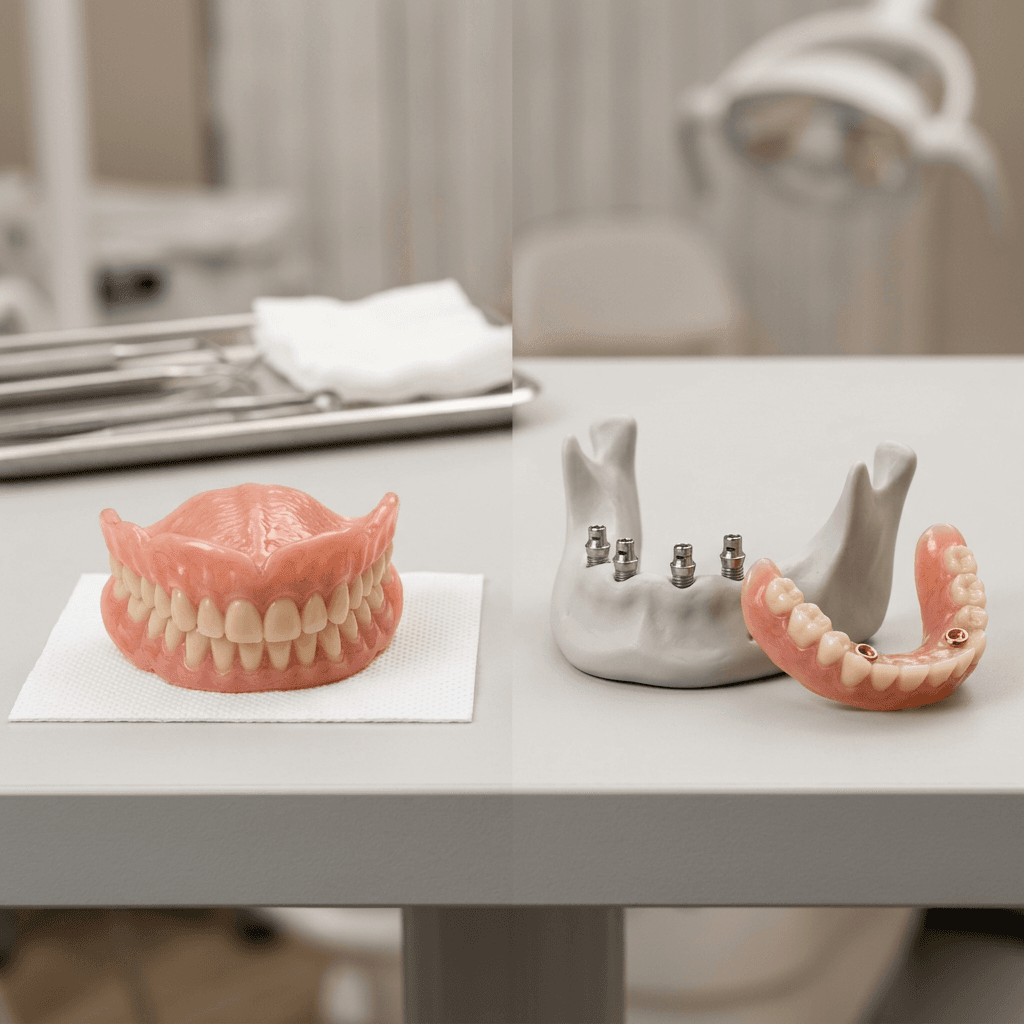
Three broad paths exist for replacing a full arch of teeth, and they differ most in how they stay in place and how they feel day to day:
| Traditional denture | Snap-in overdenture | Fixed bridge on implants | |
|---|---|---|---|
| How it stays in | Suction / adhesive on the gums | Clicks onto 2–4 implants; removable | Screwed to 4–6 implants; non-removable |
| Palate coverage (upper) | Usually covered | Often reduced | Open — taste and temperature preserved |
| Chewing function | A fraction of natural biting force | Meaningfully improved | Commonly the closest to natural teeth |
| Daily care | Remove and soak nightly | Remove nightly for cleaning | Brush and floss in place, like teeth |
| Bone stimulation | None — bone continues to resorb | Partial, at implant sites | At every implant site |
Why a Removable Plate Is a Compromise — and What Fixing It Changes
A traditional denture sits on top of the gums, which creates its familiar frustrations: shifting during conversation, food restrictions, sore spots, and adhesive routines. Chewing force with a conventional full denture is typically a small fraction of what natural teeth deliver, which is why hard and chewy foods drop off the menu. An upper plate also covers the roof of the mouth, muffling taste and temperature.
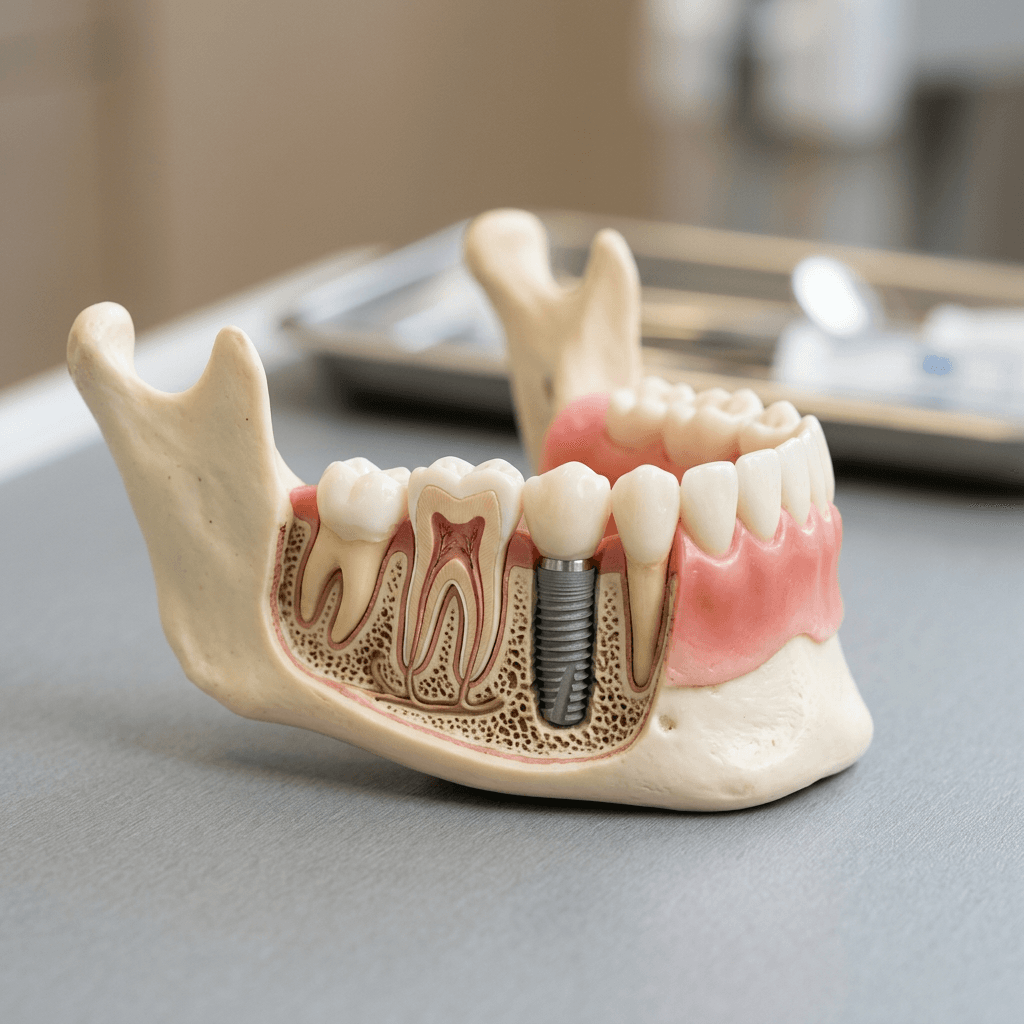
A fixed bridge changes the mechanics rather than just the fit. Because it is anchored to implants, there is no slippage to manage and no palate coverage — speech and taste tend to feel more natural, and chewing function is commonly restored to a level far closer to natural teeth. Just as important is what happens under the surface: jawbone needs stimulation to maintain its density, and implants — acting as artificial roots — provide it at each post site, helping counter the bone resorption that gives long-term denture wearers a sunken facial appearance.
The Mechanics of Stability: How 4–6 Posts Support a Full Arch
A full-arch fixed bridge does not require an implant for every missing tooth. Instead, 4–6 posts are placed at strategic positions and angles across the jaw, creating a framework that supports a bridge of roughly 10–14 teeth while spreading chewing forces evenly into the bone. The stability comes from osseointegration — over several months, bone grows onto the implant surface and locks it in place, a process described in the American Dental Association's overview of dental implants.
In All-on-X protocols, the rear implants are often tilted to engage the densest available bone — a technique that can allow patients with moderate bone loss to avoid separate grafting or sinus-lift procedures, though candidacy is always confirmed on a CBCT scan. You can read more about how these designs work at our full-arch implants practice page.
Materials: Titanium Posts, Acrylic vs. Zirconia Bridges
The posts themselves are almost always medical-grade titanium, the material with the longest research record for fusing predictably with bone. The bridge on top is where the main material choice lives: high-impact acrylic on a metal or milled frame is lighter and simpler to repair, while monolithic zirconia is harder-wearing, highly stain-resistant, and often the most natural-looking — at a higher price point.
Neither is universally right; the choice weighs your bite force, aesthetics, budget, and how the opposing arch is restored. Our guide to zirconia arches covers that decision in depth.
Fixed vs. Snap-In: The Honest Trade-Offs
Snap-in overdentures click onto a smaller number of implants and come out nightly for cleaning. They cost less, and in some severe bone-loss situations they are the more surgically practical choice. The trade-offs are daily removal, a bulkier base built to survive repeated handling, and stability that — while far better than a traditional denture — still is not the same as a bridge that is screwed in place.
A fixed bridge stays in around the clock, is slimmer because it does not need to withstand daily removal, and is maintained with brushing, floss threaders or a water flosser, and professional cleanings. For patients who want to stop thinking about their teeth as hardware, fixed is usually the endpoint. For a deeper comparison of the removable option, see our snap-in dentures guide.
“Teeth in a Day”: What Same-Day Really Means
With modern digital planning, extractions, implant placement, and the attachment of a functional temporary bridge can often happen in a single surgical visit — so you do not go home without teeth. IV sedation is available, and most patients describe the first 72 hours as manageable swelling and tenderness controlled with a personalized medication plan.
What same-day does not mean is that the biology is finished. Over the following 3–6 months, the bone fuses with the implants, and a soft-food diet protects that process. Only after integration is confirmed is the temporary replaced with the final, high-strength bridge. That sequencing is deliberate: loading a heavy final prosthesis before the foundation is ready is an avoidable cause of failure.
What Fixed Dentures on Implants Cost in the Roseville Area
At our Roseville practice — which regularly welcomes patients traveling in from Sacramento and surrounding Northern California communities — a fixed full-arch restoration such as All-on-4 commonly runs $25,000–$35,000 per arch ($50,000–$70,000 for both), with the final figure depending on implant count, grafting needs, and bridge material. Some dental plans contribute toward portions of treatment, and monthly financing can spread the investment out — our dental implant payment plans guide walks through the options.
When comparing quotes, confirm what is included: imaging, extractions, sedation, the temporary bridge, and the final prosthesis are sometimes quoted separately. An all-inclusive written plan is the only fair basis for comparison.
Why Surgeon Selection Matters More Than the Brand Name
Full-arch cases concentrate every difficult variable in implant dentistry: immediate extraction sites, angled placement near nerves and sinuses, bite engineering across an entire arch, and same-day loading decisions. Board-certified oral and maxillofacial surgeons complete years of hospital-based surgical residency beyond dental school, which matters most in complex and revision situations — low bone density, failed prior implants, or medical complexities — where experience determines what is possible.
Proximity matters too. The months between surgery and final bridge involve follow-up visits, adjustments, and occasional repairs to the temporary — having your surgical team nearby in Roseville makes that phase far more manageable than traveling long distances for each appointment.
Frequently Asked Questions
Are fixed dentures on implants painful to get?
The procedure is performed under local anesthesia, with IV sedation available, and many patients report remembering little of the appointment. Swelling and tenderness in the first 72 hours are normal and typically managed with a personalized medication plan and cold compresses. Most discomfort fades substantially within the first week.
How long do fixed implant-supported dentures last?
Once integrated, the titanium posts are designed to be a long-term — often permanent — foundation. The bridge itself experiences daily wear and commonly needs refurbishment or replacement after roughly 10–15 years, depending on material and habits. Regular professional maintenance is the biggest controllable factor in longevity.
Can I get fixed dentures if I have significant bone loss?
Often, yes. Techniques such as tilting the rear implants into denser bone — and, where needed, zygomatic implants or grafting — allow many patients with significant bone loss to be treated. A CBCT scan at consultation shows exactly what your anatomy supports; candidacy is determined case by case.
What do fixed dentures on implants cost in the Roseville area?
A fixed full-arch restoration such as All-on-4 commonly runs $25,000–$35,000 per arch in the Roseville area, with the final figure depending on implant count, grafting, and bridge material. Ask for an all-inclusive written quote covering imaging, extractions, sedation, the temporary, and the final bridge before comparing providers.
How do I clean fixed dentures if they don't come out?
Brush twice daily with a soft-bristled brush, and clean under the bridge with a water flosser, floss threaders, or interdental brushes to keep the gumline free of plaque. Professional cleanings and periodic checks of the bridge and implants complete the routine — no soaking, no adhesives.
What happens if an implant fails to fuse with the bone?
Non-integration is uncommon, and there are established protocols when it occurs: the affected post is typically removed, the site is allowed to heal, and a new implant is placed. Careful 3D planning, not smoking, and following post-operative instructions are the main ways to reduce the risk up front.
Is there a difference between All-on-4 and fixed dentures on implants?
All-on-4 is one specific technique — four strategically angled implants supporting a full arch. “Fixed dentures on implants” is the broader category covering any non-removable full-arch bridge, whether it uses four, five, or six posts. The right configuration depends on your bone density and bite forces.
Do I really get teeth the same day as surgery?
In most qualifying cases, yes — a functional temporary bridge is attached at the surgical visit, so you leave with teeth. The final, high-strength bridge is placed months later, after the bone has fused with the implants. A soft-food diet protects the healing process in between.
Find Out if a Fixed Full-Arch Bridge Is Right for You
Schedule a free implant consultation with Dr. Antipov in Roseville — 3D CBCT imaging, a straight answer on whether fixed or snap-in suits your anatomy and budget, and one transparent written plan covering every stage through the final bridge. Restrictions apply.
Book a Free Consultation