Full Mouth Dental Implants in California: Costs, Procedures, and Expert Results
Medically reviewed by Dr. Alexander V. Antipov, DDS — Board-Certified Oral & Maxillofacial Surgeon · Diplomate, American Board of Oral & Maxillofacial Surgery (ABOMS) · California Dental License #50724

Full mouth dental implants replace every tooth in an arch with a fixed bridge anchored on titanium posts — and in California in 2026, a complete All-on-4 arch typically runs $25,000–$35,000 in the Sacramento region, with coastal-market quotes often climbing well beyond that, says Dr. Alexander Antipov, a board-certified oral and maxillofacial surgeon in Roseville, CA. For many patients, the daily reality of loose dentures makes something as simple as ordering a steak feel impossible — and the volume of conflicting information about costs and surgical techniques only adds hesitation to the hope. This guide provides the clinical clarity you need: how full-arch restoration goes beyond aesthetics to preserve your jawbone, how All-on-4 technology and 3D imaging make same-day transformations predictable, what genuinely drives California pricing, and what the journey looks like from your first 3D consultation to your permanent smile.
This article is for general education and is not a substitute for a clinical evaluation. Your candidacy, implant count, and exact cost depend on your bone volume and medical history — all assessed with 3D CT imaging at an in-person consultation, after which you should receive a written, all-inclusive quote.
Beyond Traditional Dentures: A Rebuilding, Not a Cover-Up
A full mouth restoration isn't a cosmetic upgrade — it's a fundamental rebuilding of your oral health. A series of titanium posts is placed directly into the jawbone to act as artificial tooth roots, providing a permanent foundation for a custom-crafted bridge that replaces every tooth in the arch. The process relies on osseointegration — the bone physically fusing with the titanium, as the National Institute of Dental and Craniofacial Research's overview of dental implants explains — and it's that bond that stops the jawbone from shrinking away.
Dentures don't address that underlying bone loss. Without roots stimulating the jaw, the bone deteriorates, leading to the sunken lower face clinicians call facial collapse. Add the slipping, clicking, relining, and adhesives, and a denture is a temporary fix that often creates more problems than it solves. Here is how the two solutions actually compare:
| Full-arch implants (fixed) | Traditional dentures (removable) | |
|---|---|---|
| Jawbone | Osseointegrated posts stimulate bone and stop resorption | Bone shrinks steadily — the cause of “facial collapse” |
| Chewing power | 90%+ of natural bite force — apples and steak are back on the menu | A fraction of natural force; fibrous foods become difficult |
| Stability | Fixed to implants — no slipping, clicking, or adhesives | Shifts during speech and meals; needs relines as bone changes |
| Palate | No plastic covering the roof of the mouth — clearer speech, full taste | Bulky acrylic plate covers the palate |
| Lifespan | Posts engineered to last a lifetime; bridge serviceable for decades | Typically replaced every 5–7 years as the jaw changes |
The Technology: All-on-4, All-on-6, and Digital Precision
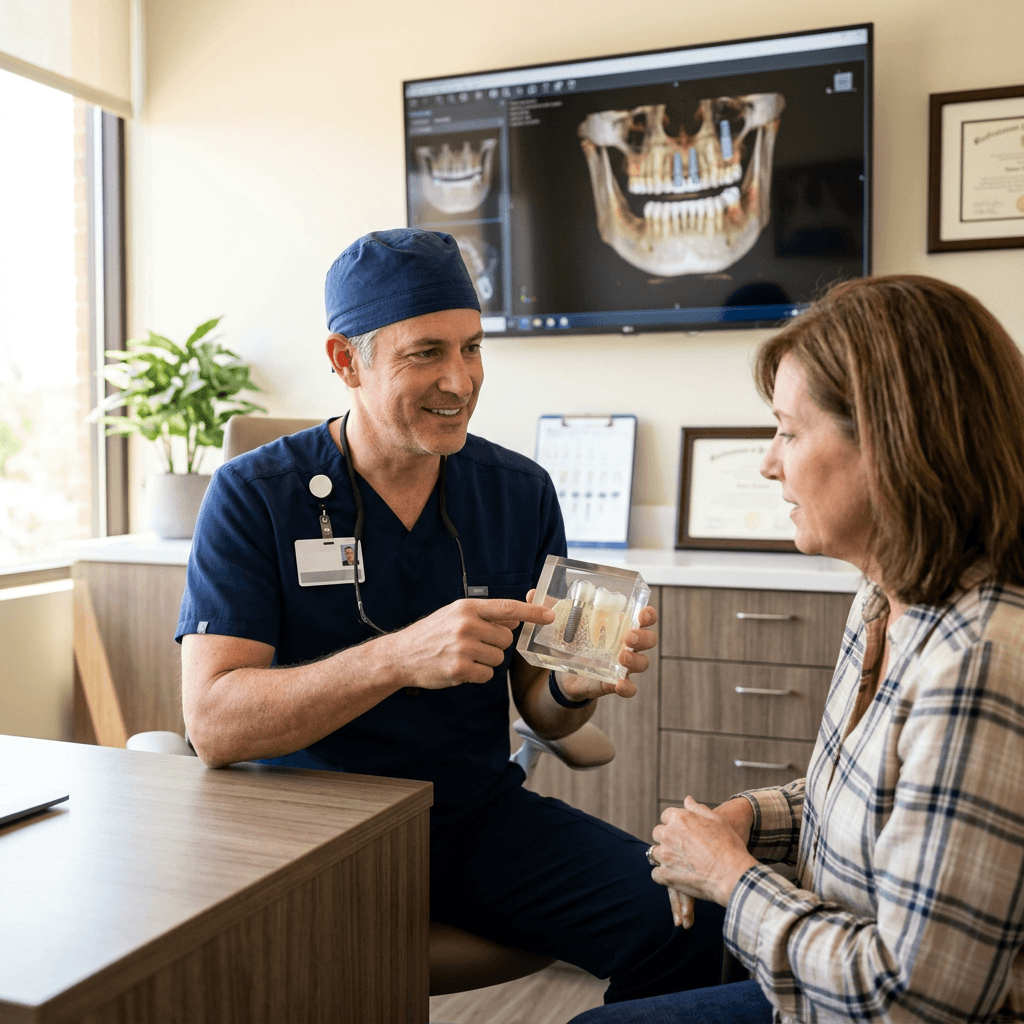
Many patients arrive asking for “All-on-4” by name, but your bone density may make an All-on-6 approach the better engineering choice — more anchors provide extra stability for larger jaws or softer bone. Our comparison of All-on-4 vs. All-on-6 walks through how the count is chosen. What matters is a surgeon who prioritizes your specific anatomy over a one-size-fits-all brand name.
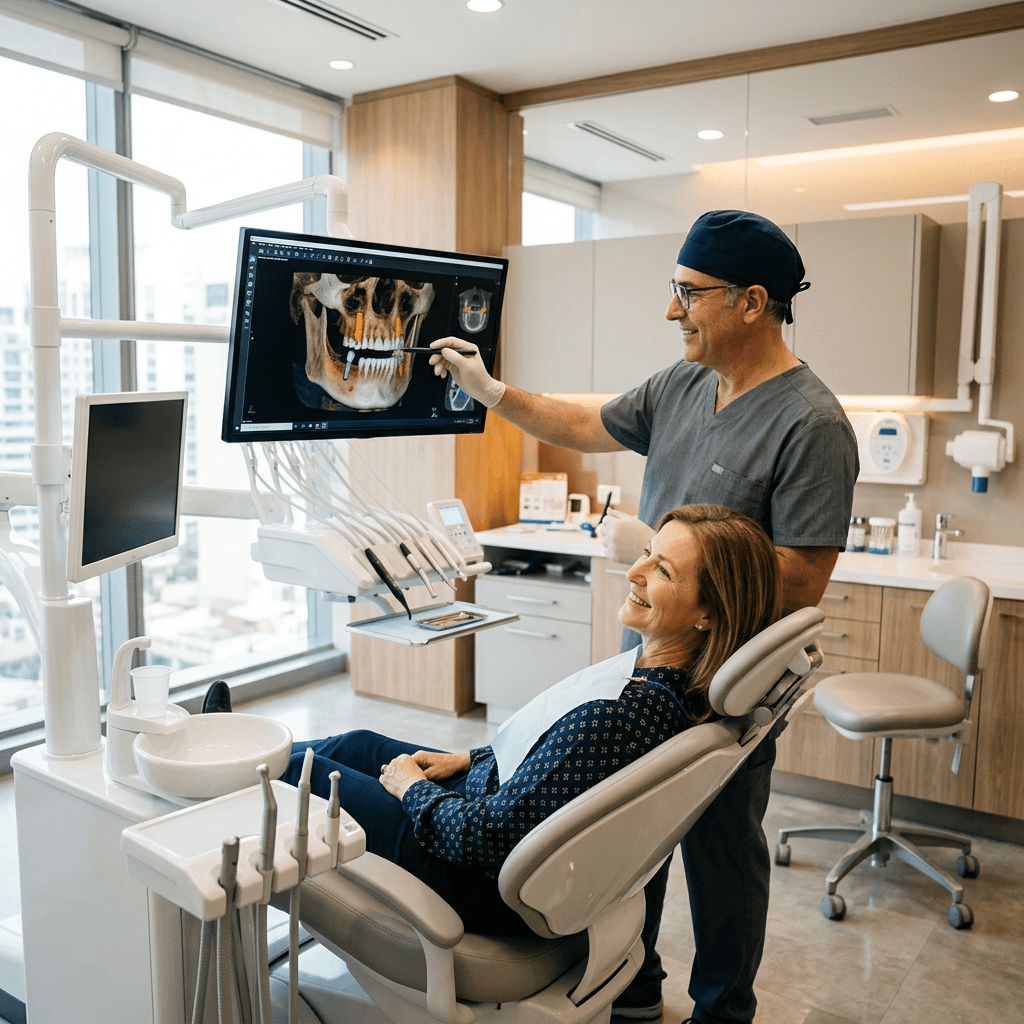
Precision is the hallmark of modern full-arch work. 3D CT scanning maps your entire oral structure — the densest bone, the nerve pathways, the sinus floor — and computer-guided software lets the surgeon perform the procedure virtually before you ever sit in the chair. That digital foresight shortens surgical time, reduces trauma, and streamlines recovery.
Zirconia vs. Titanium-Reinforced Acrylic: Choosing Your Bridge
The bridge material determines how your smile looks and how long it lasts. Zirconia is widely considered the premium choice — superior stain resistance, chip resistance, and translucency that matches natural enamel, with aesthetics that hold up better over a ten-year horizon. Titanium-reinforced acrylic is a lighter, more cost-effective alternative that's easier to repair. Our deep dive into zirconia full-arch restorations compares the materials in detail, including how gum-contoured prosthetics blend seamlessly with your natural soft tissue.
What Full Mouth Dental Implants Cost in California in 2026
In the Roseville and Sacramento region in 2026, a complete single arch of All-on-4 implants typically ranges from $25,000 to $35,000 all-in, and full upper-and-lower restoration commonly falls between $50,000 and $70,000 — with California pricing overall running 20–30% above the national average, and coastal markets frequently quoting more than the Sacramento region for identical materials. Our full mouth dental implants cost guide maps the local numbers, and our All-on-4 cost calculator builds an instant on-screen estimate for your selections.
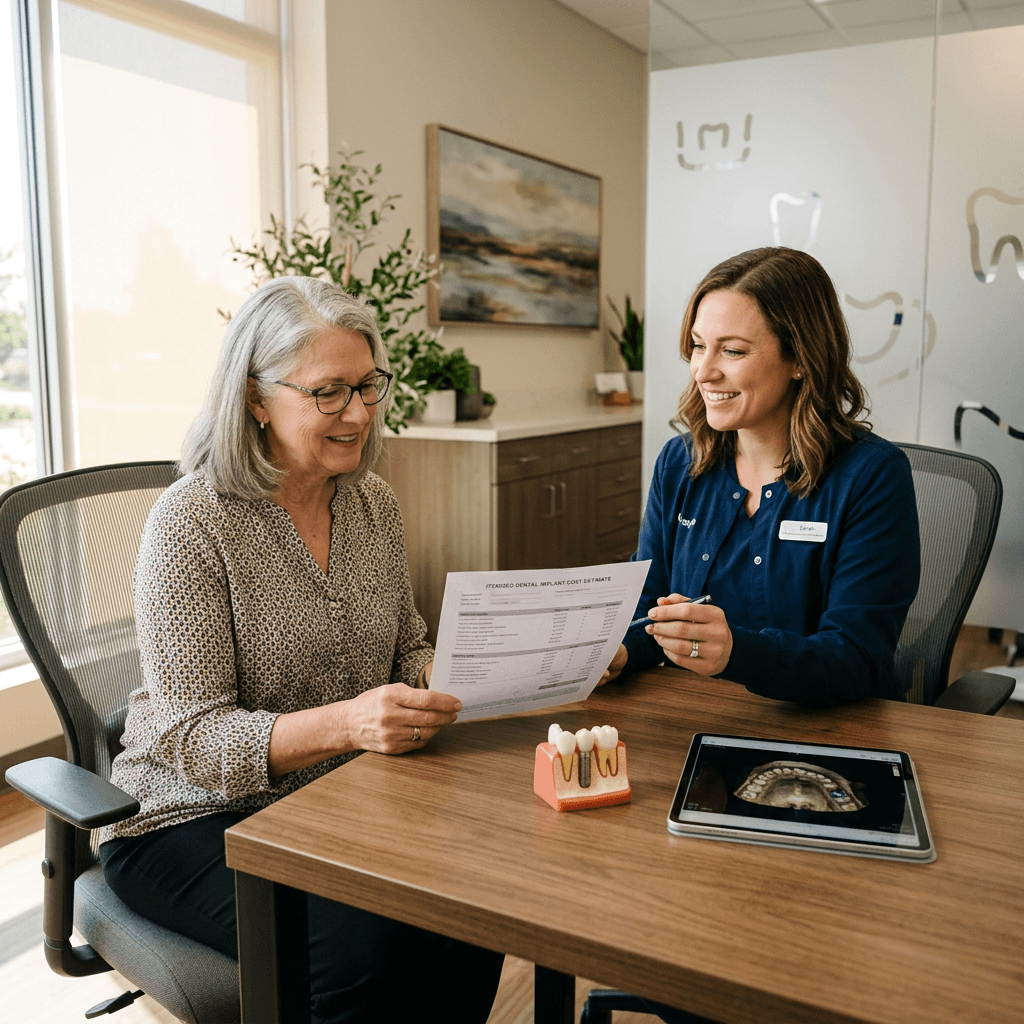
Several clinical factors move your final quote: extractions, bone grafting where needed, and your choice of sedation. When comparing quotes, always demand the “all-in” price — some clinics advertise a low starting rate that covers only surgical placement of the posts, excluding the final prosthetic teeth, 3D imaging, and follow-up care. And be wary of choosing on discount price alone: implants placed incorrectly by less experienced providers are the leading source of expensive revision surgeries.
Financing Your New Smile
Many California patients use third-party financing through providers like CareCredit or Proceed Finance to break the total into manageable monthly payments, and HSA/FSA funds can typically be applied for meaningful tax advantages. Our guide to dental implant financing options ranks the strategies by savings, and Dr. Antipov's office backs its quotes with a price-match guarantee for comparable written treatment plans from board-certified specialists in the region.
Candidacy and the Surgical Journey: What to Expect
The journey begins with a 3D CT consultation that creates a digital map of your jaw, letting a board-certified oral and maxillofacial surgeon identify precise implant positions before the procedure begins. On surgery day, any failing teeth are gently extracted and the titanium implants placed — under IV sedation, most patients remember very little. Before you leave, a functional temporary “healing bridge” is attached so you speak and smile with confidence while osseointegration proceeds. Once healing completes, your final prosthetic is fitted with meticulous bite adjustments.
Told you have “low bone density”? That's rarely the end of the road. Tilted All-on-4 implants bypass low-density areas and often eliminate grafting entirely; more advanced cases can be rebuilt with sinus lifts or targeted grafting. Our guide to dental implants with severe bone loss covers every path — even patients turned away elsewhere often qualify after a specialized evaluation.
Recovery is front-loaded: a few days of minor swelling managed with standard medication, a soft-food diet for several weeks, then a clear timeline back to crunchy and chewy foods. Long term, your new smile needs the same care as natural teeth — good home hygiene and regular professional cleanings.
Choosing Your California Specialist
A full-arch decision affects your health, function, and confidence for decades, so the provider matters as much as the protocol. Patients travel to Dr. Antipov's Roseville office from across Northern California for full-arch restorations and complex revision cases precisely because board-certified surgical training is what handles challenging anatomy predictably. You deserve a team that educates you on the reasoning behind every clinical decision — from the physics of implant stability to the nuances of zirconia craftsmanship — so you move from uncertainty to informed confidence.
Frequently Asked Questions
How much do full mouth dental implants cost in California for 2026?
In the Roseville and Sacramento region, a complete All-on-4 arch typically runs $25,000–$35,000 all-in, and full upper-and-lower restoration commonly falls between $50,000 and $70,000 — with California pricing overall about 20–30% above the national average, and coastal markets often higher still. Always request an all-in quote that includes extractions, 3D imaging, sedation, and the final bridge to avoid hidden fees.
Is the full mouth dental implant procedure painful?
You won't feel pain during surgery — IV sedation and local anesthetic keep you relaxed and comfortable throughout, and most patients remember very little. Post-operative recovery is typically described as mild soreness or pressure, managed with standard medication for three to five days.
How long do full-arch dental implants last?
The titanium posts are engineered to be permanent — 10-year success rates run between 95% and 98%, and with proper hygiene the surgical foundation can last a lifetime. The prosthetic bridge may need minor maintenance after decades of wear, but the implants themselves are built for long-term reliability.
Can I get full mouth implants if I have significant bone loss?
Often, yes. Tilted implants anchor into the densest available areas of the jaw and frequently bypass the need for grafting. In more advanced cases, sinus lifts or regenerative bone grafting rebuild the foundation. Eligibility is higher today than it has ever been — even patients turned away elsewhere often qualify after a specialized 3D evaluation.
Will my dental insurance cover full mouth dental implants?
Most plans offer only limited support for complex surgical procedures — a portion of the extractions or the final bridge may be covered, but the surgical placement of the implants rarely is. Dr. Antipov's team helps you navigate your benefits and offers financing options to make treatment accessible.
What is the difference between All-on-4 and “Teeth in a Day”?
All-on-4 is the surgical technique: four strategically placed implants supporting an entire arch. “Teeth in a Day” describes the immediate-loading protocol, where a functional temporary bridge is attached the same day as surgery — so you leave with a complete smile while the implants heal.
How do I clean and maintain a permanent implant bridge?
Much like natural teeth — a soft-bristle toothbrush plus a water flosser to clean between the bridge and the gum line. Regular professional cleanings remain essential to monitor tissue health and protect the long-term stability of the restoration.
How long is the recovery after full-arch surgery?
Most patients feel comfortable returning to work within two to three days. Initial soft-tissue healing takes about a week, while the bone needs three to six months to fully fuse with the implants. During that osseointegration phase you'll wear a functional temporary bridge and follow a soft-food diet.
Start With a 3D Map of What's Possible
Schedule a free implant consultation with Dr. Antipov in Roseville — you'll get 3D CT imaging, a clear answer on your candidacy even with bone loss, and one transparent, all-inclusive written quote backed by a price-match guarantee. Restrictions apply.
Book a Free Consultation