Alternatives to Dental Bridges: Every Option Compared for 2026
Medically reviewed by Dr. Alexander V. Antipov, DDS — Board-Certified Oral & Maxillofacial Surgeon · Diplomate, American Board of Oral & Maxillofacial Surgery (ABOMS) · California Dental License #50724
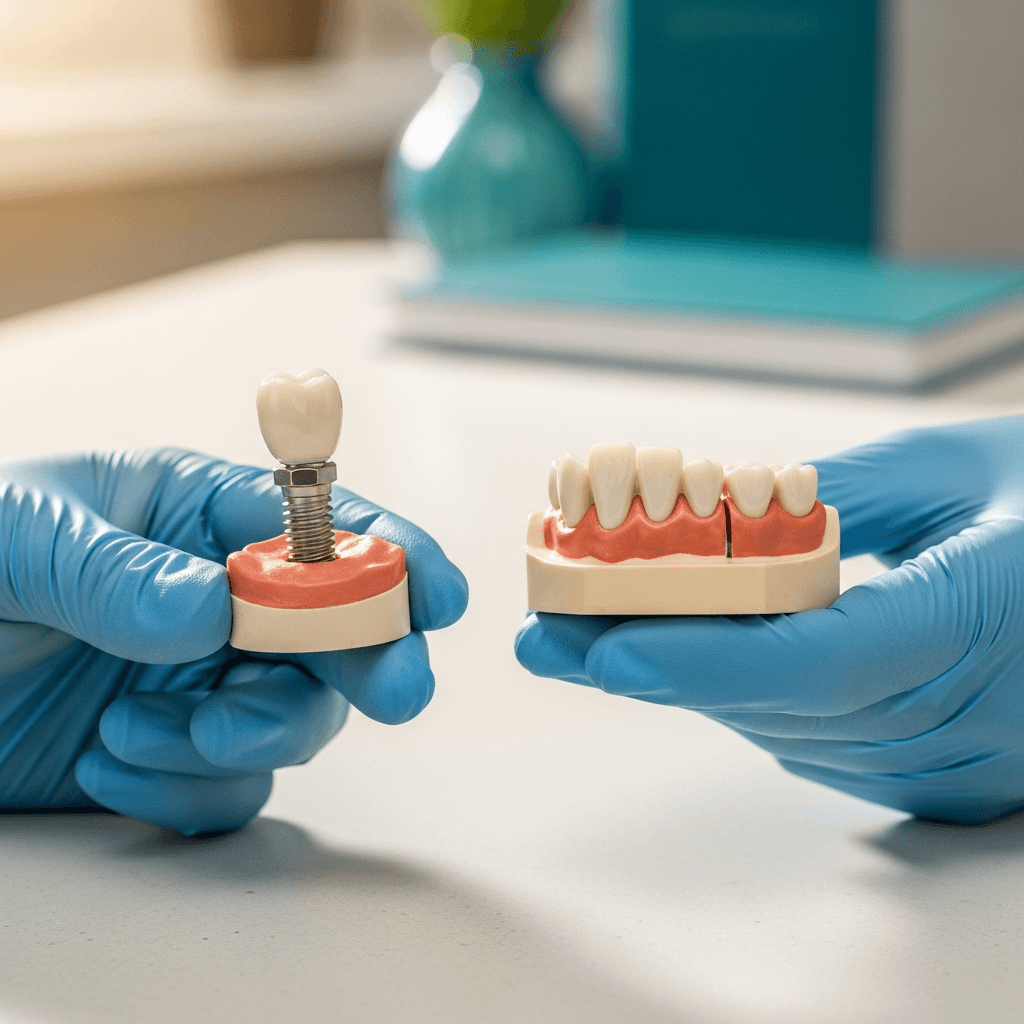
The main alternatives to a dental bridge are a single-tooth implant, a removable partial denture, a resin-bonded Maryland bridge, and — in select cases — orthodontic space closure, and only the implant replaces the tooth's root and stops the jawbone loss that follows extraction, explains Dr. Alexander Antipov, a board-certified oral and maxillofacial surgeon in Roseville, CA. The reason so many patients look for alternatives is the bridge's biological price tag: to anchor it, the healthy teeth on either side of the gap must be ground down and crowned, permanently weakening teeth that may have nothing wrong with them. This guide compares every realistic option on the factors that matter — what happens to your bone, how long each solution lasts, and what each really costs over decades rather than at checkout.
This article is for general education and is not a substitute for a clinical evaluation. The right replacement depends on the condition of your neighboring teeth, your bone anatomy, and your bite — all assessed at an in-person consultation.
Every Bridge Alternative at a Glance
Here is how the realistic options for replacing a missing tooth compare:
| Option | Fixed or removable? | Neighboring teeth | Stops bone loss? | Typical lifespan |
|---|---|---|---|---|
| Traditional bridge | Fixed | Ground down and crowned | No | About 7–15 years |
| Removable partial / flipper | Removable | Untouched (clasps may stress them) | No | A few years; frequent adjustments |
| Maryland (resin-bonded) bridge | Fixed | Minimal preparation; wings bonded to backs | No | Shorter; prone to debonding, front teeth only |
| Orthodontic space closure | N/A — moves your own teeth | Repositioned, not cut | Yes — your own roots move in | Permanent if retained |
| Single-tooth implant | Fixed | Completely untouched | Yes — replaces the root | Designed to last decades |
The Problem With Traditional Bridges: Sacrificial Anchor Teeth
A bridge works by cutting down the two teeth flanking the gap and cementing crowns over them, with the replacement tooth suspended between. If those anchor teeth are healthy, that enamel removal is a permanent step backward: the prepared teeth become more vulnerable to sensitivity, decay under the crowns, and in some cases eventually need root canals. And a bridge is rarely a lifetime fix — when it fails, the anchor teeth often fail with it, turning a one-tooth problem into a three-tooth problem. Our detailed cost comparison of a single implant versus a bridge runs those numbers over a 25-year horizon. The American Dental Association's overview of dental bridges covers the basics of how they work.
There is one scenario where a bridge still makes practical sense: when the neighboring teeth are already heavily filled or crowned. In that case, crowning them anyway restores two compromised teeth while filling the gap. But when the neighbors are healthy, preserving them should be the priority — and that rules the traditional bridge out for many patients.
Non-Surgical Options: Partials, Flippers, and Maryland Bridges
A removable partial denture — or the lightweight acrylic “flipper” used for a single front tooth — is the fastest, lowest-cost way to fill a gap. No surgery, no tooth preparation. The trade-offs are daily-life ones: partials can feel bulky, affect speech, come out nightly for cleaning, and do nothing for the bone beneath. They shine as a temporary solution during healing or while planning a permanent restoration, not as a decades-long answer.
The Maryland bridge is the conservative cousin of the traditional bridge: instead of crowns, thin porcelain or metal “wings” are resin-bonded to the backs of the neighboring teeth. It avoids heavy grinding, which is genuinely appealing — but it belongs almost exclusively on front teeth, where biting forces are light. Under molar-level chewing pressure the bond tends to fail, leading to a cycle of debonding and re-cementing. It is a reasonable medium-term fix for a front tooth, especially for younger patients still growing, but not a heavy-duty solution.
Orthodontic space closure is the option most people never hear about: using braces or clear aligners to move your own teeth into the gap, eliminating the need for any prosthetic. It is entirely biological — your own roots keep the bone stimulated — but it only works when the bite alignment and tooth positions cooperate, most often for certain front-tooth or crowded-arch situations. It also takes the longest of any option.
The Bone-Health Factor Most Comparisons Skip
Everything above the gum line is cosmetics; the decisive difference between these options is what happens below it. Your jawbone maintains its density only while tooth roots load it through chewing. Lose the root and the body starts reclaiming that bone — noticeably within the first year — and neither a traditional bridge, a partial, nor a Maryland bridge does anything to stop it. Under a bridge, the receding ridge eventually opens a food-trapping gap beneath the false tooth; with a partial, the shrinking ridge means endless relines. Our guide to implants versus dentures explores the same biology at full-arch scale.
A single-tooth implant is the only prosthetic option that solves this: the titanium post fuses with the jaw through osseointegration and transmits chewing forces into the bone the way the natural root did. That is why implants both protect your facial structure and spare you the more involved bone grafting that becomes necessary when replacement is delayed for years. If you're weighing options for a visible gap, our guide to missing front tooth replacement covers the aesthetic-zone specifics.
Already Have a Failing Bridge?
Many patients researching alternatives already have a bridge that is loosening, trapping food, or hiding decay under its crowns. Transitioning from a failed bridge to implants is one of the most common procedures in Dr. Antipov's practice: the bridge is removed, the anchor teeth are evaluated (and sometimes saved), the bone underneath is assessed on a 3D CBCT scan, and grafting rebuilds any lost foundation before implants go in. Our guide to replacing old, failing bridges with implants walks through that process — and when several teeth are failing at once, a full-arch restoration can reset the entire situation in one plan.
Lifetime Cost and Getting Specialist Care in Roseville
Compare cost per year, not sticker price. A bridge that needs replacing every decade or so — with the risk of anchor-tooth damage compounding at each cycle — is often more expensive over 25 years than an implant placed once and maintained like a natural tooth. Dr. Alexander Antipov is a board-certified oral and maxillofacial surgeon who plans every case on 3D CBCT imaging, places implants with IV sedation available, and serves patients from Roseville, Rocklin, Granite Bay, Citrus Heights, Folsom, and Sacramento. His practice backs transparent, all-inclusive quotes with a price-match guarantee, and financing options can spread the investment into monthly payments.
Frequently Asked Questions
Is a dental implant always better than a bridge?
Usually, but not always. An implant is superior when the neighboring teeth are healthy — it leaves them untouched and stops bone loss. If the neighbors are already heavily filled or need crowns anyway, a bridge can be a practical two-birds-one-stone choice. A specialist consultation with 3D imaging settles which applies to you.
What is the cheapest alternative to a dental bridge?
A removable partial denture — especially an acrylic 'flipper' — has the lowest upfront cost. But it doesn't stop bone loss, needs regular adjustments, and comes out nightly. Over a lifetime of relines and replacements, the total often exceeds the cost of a single implant placed once.
Can I get a dental implant if I already have a bridge?
Yes — converting a failing bridge to implants is very common. The bridge is removed, the anchor teeth and underlying bone are evaluated with a 3D CBCT scan, and if the ridge has receded, a bone graft rebuilds the foundation before the implant is placed.
How long does a Maryland bridge last?
Generally less time than a traditional bridge, because it relies on a resin bond rather than crowns. Maryland bridges work best on front teeth with light biting forces; on back teeth the wings tend to debond repeatedly. Many are used as conservative medium-term solutions rather than permanent ones.
Do dental implants feel like natural teeth?
Closer than any other option. Because the titanium post fuses with your jawbone, an implant crown doesn't slip, click, or rely on neighboring teeth — you bite, chew, and floss around it like a natural tooth. Most patients stop thinking about it entirely.
What happens if I just leave the gap?
The jawbone under the gap begins resorbing without root stimulation, neighboring teeth drift and tilt into the space, and the opposing tooth can over-erupt. Waiting years typically means bone grafting is needed before an implant can be placed, adding time and cost to what would have been a simpler procedure.
Is implant surgery painful?
Most patients find it far more comfortable than expected. A single implant is placed under local anesthesia — with IV sedation available for anxious patients — and many describe the procedure as easier than a tooth extraction. Swelling typically peaks within 48–72 hours and discomfort is manageable with medication.
Weighing a Bridge Against the Alternatives?
At a consultation with Dr. Antipov in Roseville, you'll get 3D CBCT imaging, an honest comparison of every option for your specific tooth — including whether a bridge actually makes sense in your case — and a transparent, all-inclusive quote backed by a price-match guarantee. Restrictions apply.
Book a Consultation