One Missing Tooth: Choose the Replacement Around the Whole Site
By Dr. Alexander V. Antipov, DDS. Clinical review pending.

An implant and crown, a tooth-supported bridge, or a removable partial can replace one missing tooth, but they place different demands on the surrounding mouth. Dr. Alexander V. Antipov, DDS, in Roseville can evaluate the surgical requirements of an implant while your restorative dentist helps compare the final tooth design and alternatives.
This educational comparison does not determine implant candidacy or replace an examination. Treatment sequence, temporary teeth, costs, and healing restrictions must be individualized.
Three Ways to Fill One Gap
| Option | How it is supported | Main planning trade-off |
|---|---|---|
| Implant and crown | An implant in bone supports an abutment and crown | Avoids preparing adjacent teeth for support but requires surgery and healing |
| Conventional bridge | Crowns on adjacent supporting teeth | Can avoid implant surgery but requires suitable prepared teeth |
| Removable partial | A removable appliance supported by oral tissues and/or teeth | Can provide a nonsurgical replacement but has different stability and cleaning needs |
| Resin-bonded bridge in selected sites | A bonded attachment to a neighboring tooth | More conservative preparation may be possible, but bite and bonding conditions limit suitability |
Start With the Teeth on Either Side
When neighboring teeth are intact, preserving their structure may favor an independent implant restoration. That does not make an implant automatic: bone, gums, health, and the way the teeth meet still matter. If neighboring teeth already need crowns, a conventional bridge may fit the restorative plan differently than it would between untouched teeth.
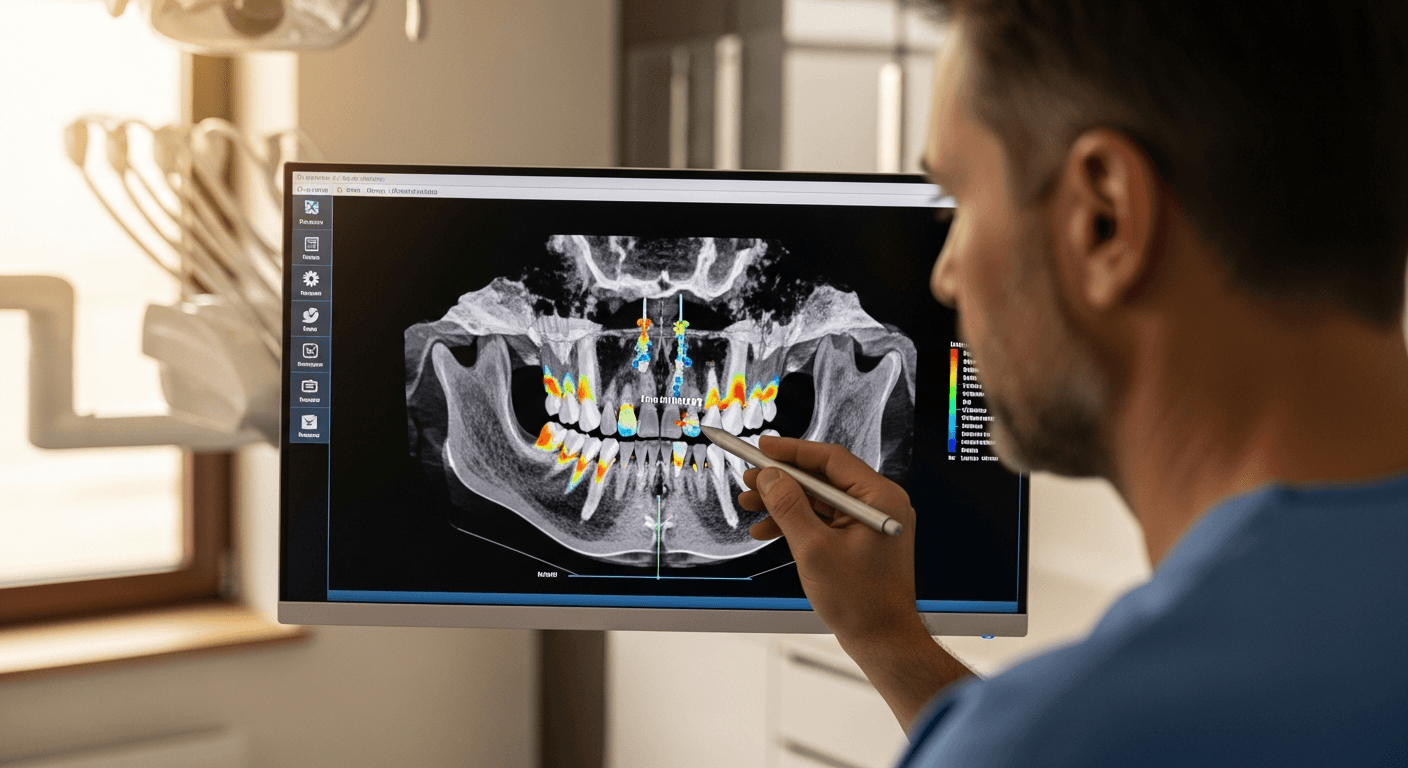
The width of the visible gap is only one measurement. Roots can lean into the space below the gums, and a narrow ridge may not accommodate the intended implant position. A crown that looks centered can still require careful planning beneath it. Examination and appropriate imaging connect the replacement tooth's position with a safe surgical site.
For the broader trade-offs, read dental bridge versus implant. This guide focuses on the decisions specific to one gap rather than full-arch replacement.
Separate Implant Placement From Getting the Final Tooth
The implant is the support placed in bone; the crown is the visible replacement. An abutment connects the two. Their appointments may be separated by healing. If a tooth still needs removal, ask whether extraction and implant placement can safely happen together or whether a staged approach offers a more appropriate foundation.
Immediate placement does not necessarily mean immediate chewing on a crown. A temporary tooth may be removable, bonded to adjacent teeth, or attached to an implant in selected cases. Stability, bite forces, soft tissue, and the procedure determine which arrangement is suitable. Ask what the backup plan is if same-visit placement is not advisable.
The ADA explains implant placement, integration, and restoration as related stages. Feeling comfortable after surgery does not prove that the implant is ready for unrestricted chewing.
A Front Tooth and a Back Tooth Raise Different Questions
For a visible front tooth, the gum contour, lip movement, tooth proportions, and match with adjacent teeth deserve attention before surgery. A crown alone cannot always disguise missing gum or bone. Old photographs can help communicate the appearance you want, but they cannot predict the exact result.
For a back tooth, available space and biting forces may be more prominent concerns. Upper back teeth can be close to the sinus, while lower sites can be near important nerves. Imaging is selected to answer those anatomical questions. A generic minimum-bone measurement from an online article is not enough to decide eligibility.
If the site needs rebuilding, discuss bone grafting before comparing timelines. Adding a healing stage may be appropriate; avoiding it is not inherently a better result.
Compare the Whole Commitment
Ask for the costs of evaluation, possible extraction, grafting, implant placement, abutment, crown, and temporary tooth to be identified. Confirm who handles each stage and whom to contact if the temporary restoration becomes uncomfortable. A low implant-only quote may exclude much of the work needed to replace the visible tooth.
Maintenance is part of every option. Implants do not get tooth decay, but the surrounding tissues can develop disease. Natural teeth supporting a bridge can still decay, and removable appliances require daily cleaning and periodic fit checks. The best choice is one you can maintain—not simply the one described as permanent.
Bring your medication list, existing X-rays, and questions about the temporary tooth to a single-tooth implant consultation. A clear plan should explain what happens if healing or the available bone differs from the initial expectation.
Frequently Asked Questions
Does one missing tooth always require one implant?
No. An implant and crown is one option; a suitable bridge or removable appliance may also replace the gap. The condition of adjacent teeth, bone, gums, and your priorities affects the choice.
Can I receive an implant when the tooth is extracted?
Sometimes. The socket, infection status, bone, tissue condition, and ability to obtain appropriate stability determine whether immediate placement is suitable. A staged plan may be recommended.
Will I have a visible gap during healing?
Ask about temporary replacement before treatment begins. Several designs may be possible, but they must avoid harmful pressure on the surgical site and suit your bite.
Can I replace a tooth that has been missing for years?
Possibly. The team needs to assess bone changes, movement of neighboring teeth, and the available restorative space. Grafting or other preparatory care may be needed.
Is an implant better than a bridge between healthy teeth?
Avoiding preparation of healthy neighboring teeth can be an advantage of an implant. That benefit must still be balanced against surgery, anatomy, health, healing, cost, and maintenance.
Will the implant crown last forever?
No restoration has a lifetime guarantee. The crown or connection can require repair or replacement even if the implant remains stable, and the surrounding tissues require ongoing care.
Plan the Replacement and the Temporary Tooth Together
Request a single-tooth implant evaluation with Dr. Antipov in Roseville and compare the surgical plan with your restorative dentist's recommendations.
Discuss One-Tooth Replacement