How to Fix an Overbite: Treatment Options, Surgery & Cost
Medically reviewed by Dr. Alexander V. Antipov, DDS— Board-Certified Oral & Maxillofacial Surgeon · Diplomate, American Board of Oral & Maxillofacial Surgery (ABOMS) · California Dental License #50724
An overbite — when the upper front teeth overlap the lower front teeth too much — is one of the most common bite problems, and almost all of them are fixable, says Dr. Alexander Antipov, a board-certified oral & maxillofacial surgeon in Roseville, CA. The right approach depends on one key question: is the overbite caused by the teeth or by the jaw bones? Here is every option, from clear aligners to jaw surgery, with realistic timelines and cost.
This article is for general education — consult a qualified oral surgeon or orthodontist for a recommendation tailored to your case.
First: Dental Overbite vs. Skeletal Overbite
Every overbite treatment decision starts here, because the two types are fixed in completely different ways.
- — Dental overbite. The jaw bones are in a normal position, but the teeth are tipped or positioned so the upper teeth overlap too far. This is the common type, and it is corrected by moving the teeth with aligners or braces.
- — Skeletal overbite. The upper and lower jaw bones are misaligned — for example, the lower jaw sits too far back. Moving teeth alone cannot fix the underlying bone position, so the jaw itself is repositioned with corrective jaw surgery.
A clinical exam plus a 3D CT scan tells the two apart with certainty. For a deeper look at the surgical category, see our guide on severe overbite and when jaw surgery is needed.
How Severe Is Your Overbite?
| Severity | Overlap | Typical Treatment |
|---|---|---|
| Normal | 1–3 mm | None needed |
| Slight / mild | 4–6 mm | Clear aligners or braces |
| Moderate | 6–9 mm | Braces, sometimes with extractions or TADs |
| Severe | 9+ mm | Often jaw surgery + orthodontics |
Severity is a guide, not a verdict — the cause (dental vs. skeletal) matters more than the number of millimeters.
Option 1: Clear Aligners
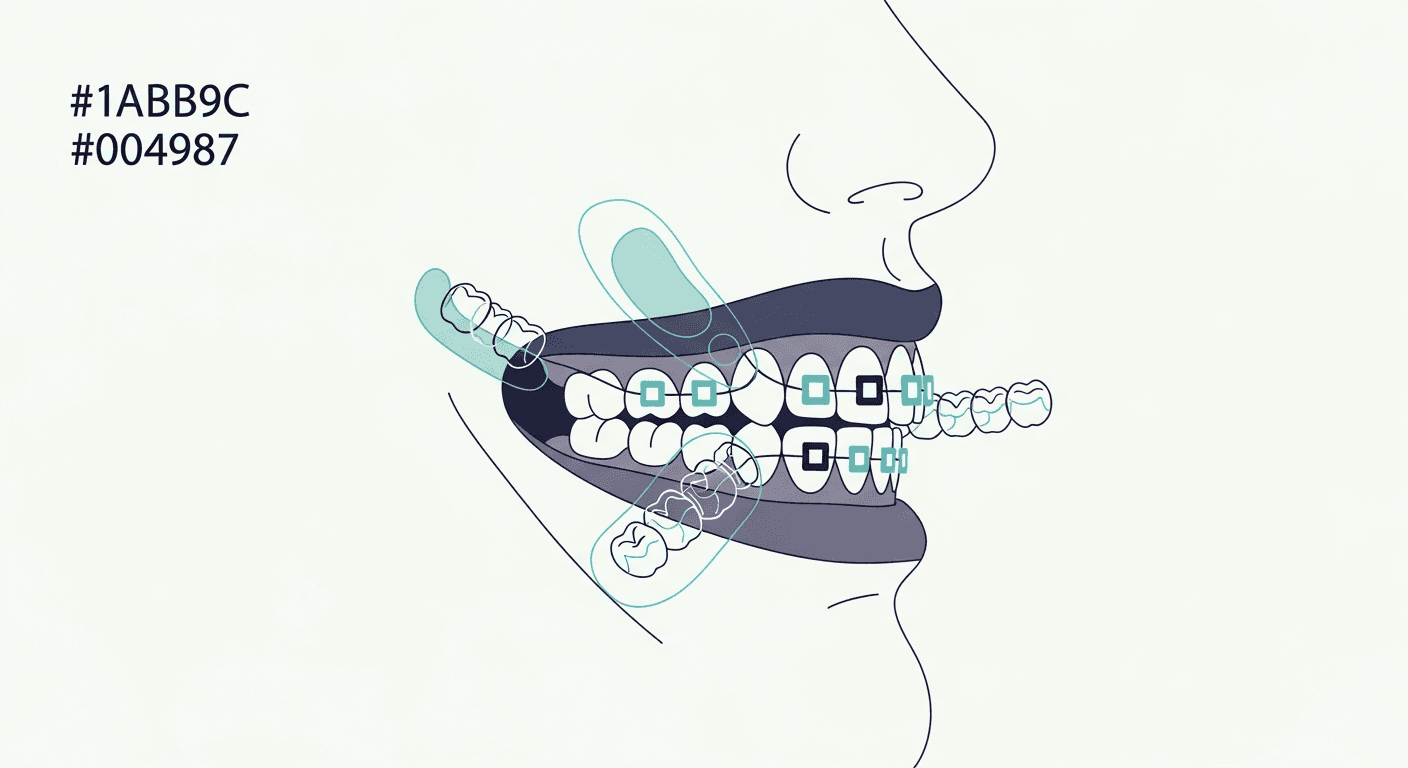
Clear aligners (such as Invisalign-type systems) are a popular choice for slight to moderate dental overbites. A series of clear, removable trays gradually moves the teeth, often with small tooth-colored attachments and elastics to control the bite. They are nearly invisible and removable for eating and cleaning.
- — Best for: slight to moderate dental overbites in teens and adults.
- — Timeline: roughly 6–18 months.
- — Cost: about $3,000–$7,000.
- — Trade-off: depends on wearing them 20–22 hours a day.
Option 2: Braces
Traditional or ceramic braces remain the most versatile tool for overbite correction, especially for moderate cases or when precise, complex tooth movement is needed. Braces can be paired with elastics or small temporary anchorage devices (TADs) to intrude or reposition teeth that aligners struggle with.
- — Best for: moderate dental overbites and complex cases.
- — Timeline: roughly 12–24 months.
- — Cost: about $3,000–$8,000.
Option 3: Growth Appliances (Children & Teens)
In growing children and teens, the jaw can still be guided. Functional appliances and headgear can influence how the jaws develop, sometimes preventing a skeletal overbite from requiring surgery later. This is why early orthodontic evaluation (around age 7) is recommended for kids with an obvious bite problem — the same overbite is often simpler to address while the patient is still growing.
Option 4: Corrective Jaw Surgery (Skeletal Overbites)
When the overbite is skeletal — the jaw bones themselves are misaligned — orthodontics is combined with orthognathic (corrective jaw) surgery. The surgeon repositions the upper jaw, lower jaw, or both and secures them with small titanium plates and screws placed from inside the mouth (no facial scars). This is the only way to achieve a stable correction for true skeletal cases in adults.
- — Best for: severe or skeletal overbites in adults, or cases with TMJ pain, sleep apnea, or facial-profile concerns.
- — Timeline: an 18–36 month coordinated plan (braces → surgery → finishing orthodontics).
- — Cost: typically $25,000–$60,000 for the full plan, often 60–90% covered by medical insurance when functional impairment is documented.
Read the full breakdown in our guide to severe overbite and jaw surgery.
Fixing an Overbite as an Adult
Adults are treated successfully every day — teeth move at any age. The only real difference is that an adult’s jaw bones have stopped growing, so growth appliances no longer work. That means an adult with a dental overbite is treated with aligners or braces, while an adult with a skeletal overbite is treated with orthodontics plus jaw surgery. Treatment can take a little longer in adults because bone remodels more slowly, but the results are just as reliable.
Why It Is Worth Fixing
Beyond appearance, correcting a significant overbite protects your long-term oral health by reducing abnormal tooth wear, preventing lower teeth from biting into the palate, easing strain on the jaw joints (TMJ), and improving chewing — and, in skeletal cases, breathing and sleep.
Frequently Asked Questions
How do you fix an overbite?
Most overbites are fixed by moving the teeth with clear aligners or braces. When the overbite is caused by the jaw bones being misaligned (a skeletal overbite), orthodontics is combined with corrective jaw surgery. The right option depends on whether the cause is dental or skeletal, and on your age.
Can you fix an overbite without surgery?
Yes — the large majority of overbites are corrected without surgery using clear aligners or braces, sometimes with small attachments, elastics, or temporary anchorage devices. Surgery is only needed for severe skeletal overbites where the jaw position itself must be changed.
How do you fix a slight overbite?
A slight overbite (around 4–6 mm of overlap) is usually corrected with clear aligners or braces over roughly 6–18 months. Many mild cases are treated for function and appearance, though a small overbite that causes no problems may not need treatment at all.
Can an overbite be fixed in adults?
Absolutely. Teeth can be moved at any age, so adults are routinely treated with aligners or braces. The difference is that an adult's jaw bones have stopped growing, so skeletal overbites in adults are corrected with jaw surgery rather than growth-guiding appliances.
How much does it cost to fix an overbite?
Clear aligners or braces for an overbite typically run $3,000–$8,000. When corrective jaw surgery is required, the complete plan (orthodontics plus surgery) generally falls in the $25,000–$60,000 range, though medical insurance often covers 60–90% of the surgical portion when functional impairment is documented.
What happens if an overbite is left untreated?
A mild overbite may never cause problems. Larger overbites can lead to abnormal tooth wear, gum damage where lower teeth bite into the palate, jaw-joint (TMJ) strain, difficulty chewing, and in some cases speech or breathing issues. Treating it earlier is generally simpler than treating it later.
Not sure which type of overbite you have?
A 3D CT consultation with Dr. Antipov shows exactly whether your overbite is dental or skeletal — and the simplest path to correct it.
Book a Consultation