Challenges of Lower-Jaw Tooth Loss
The lower jaw, or mandible, presents unique challenges when teeth are lost. Lower dentures are notorious for being unstable because there is less surface area and the tongue and muscles tend to dislodge them. Many patients in Roseville, Sacramento, and Placer County struggle with a lower denture that slips while eating or speaking.
A loose lower denture can also create sore spots, limit the foods a person feels confident eating, and make social situations stressful. Because the lower ridge tends to shrink after tooth loss, a denture that once fit reasonably well often becomes looser with time, leading to a frustrating cycle of adhesives and relines.
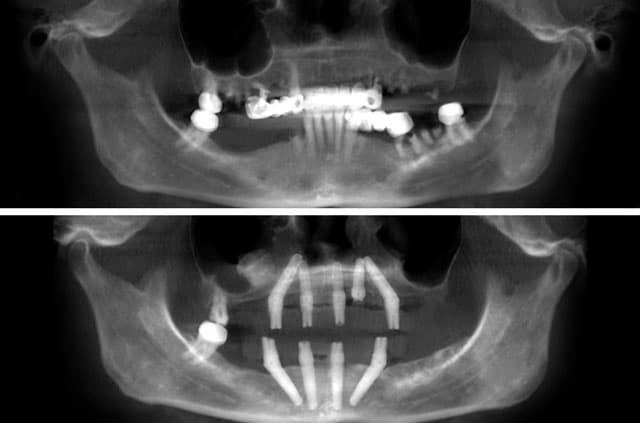
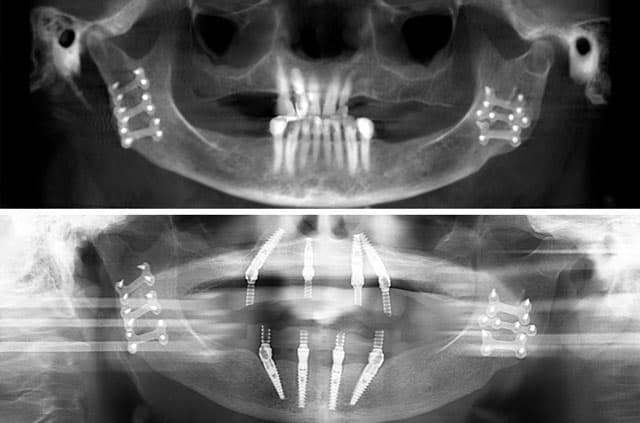
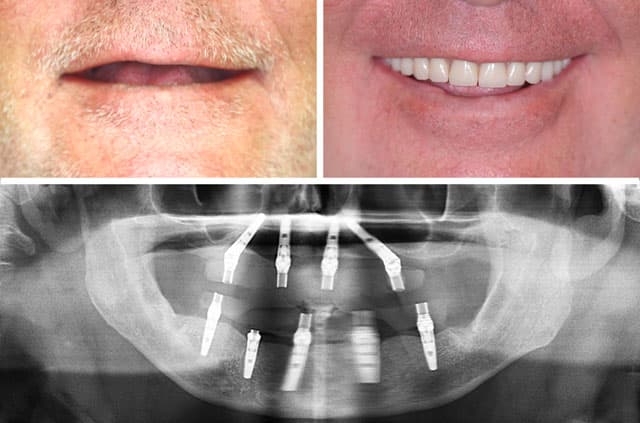
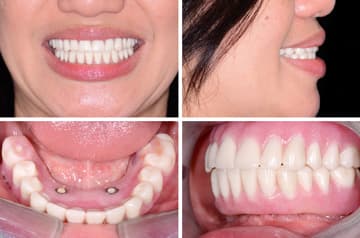
Full-arch dental implants address this problem directly by anchoring the new teeth to the jawbone instead of resting them on the gums. This case focused on rehabilitating the lower jaw with the All-on-4 technique, providing a fixed, stable foundation for a complete arch of teeth.
The All-on-4 Approach in the Lower Jaw
All-on-4 restores a full arch of teeth on four implants. In the lower jaw, the front portion of the mandible typically offers dense, supportive bone, which makes it a favorable region for implant placement. By concentrating the implants in the anterior lower jaw and angling them for stability, the technique can support an entire arch reliably.
Placing the rear implants at an angle also helps the surgeon keep a safe distance from important structures such as the nerve that runs through the lower jaw, while still extending support farther back to carry the chewing teeth. This thoughtful positioning is central to the predictability of the All-on-4 design.
Spreading the chewing load across four well-positioned implants allows a fixed bridge to function much like natural teeth. For the right candidate, this means a secure result that does not need to be removed and that restores confident chewing and speaking. The dense bone often found at the front of the mandible is also one reason immediate loading is frequently possible in the lower jaw when the implants achieve strong initial stability.
Procedures Performed in This Case
The treatment included All-on-4 dental implants on the mandible, with four implants placed in the anterior lower jaw. Positioning the implants in the front of the lower jaw takes advantage of the strong bone available there, providing a dependable anchor for the full-arch prosthesis.
Concentrating the implants in this region allows the back teeth of the bridge to be supported by the angled posterior implants, distributing the bite across the arch. This balance helps the restoration handle everyday chewing while keeping the foundation stable.
Temporary dentures were placed the same day as part of a Teeth-In-A-Day surgical solution, so the patient left with fixed teeth rather than going without during healing. This immediate-load approach restores function and appearance right away while the implants integrate with the bone over the following months.
Dr. Alexander V. Antipov performed this lower-jaw rehabilitation, planning implant placement to maximize stability and to support immediate function on the day of surgery.
Recovery and Osseointegration
Following full-arch implant surgery, patients usually experience swelling and tenderness for several days, which is managed with rest and the instructions provided by the surgical team. A softer diet during the early healing period helps protect the implants while the bone begins to fuse around them.
Over the next few months, the implants integrate with the jawbone through osseointegration, building a strong, lasting foundation. During this window, the temporary teeth are kept to gentler function so the integrating implants are not overstressed, which is why following dietary guidance early on is so important.
After healing is complete, a final prosthesis is typically crafted to deliver optimal fit, strength, and appearance for the long term, with follow-up visits to monitor progress. The move from the provisional to the final restoration lets the team confirm the bite and aesthetics on fully healed tissue. These timelines reflect what patients can generally anticipate; individual healing varies, and the surgeon adjusts the plan to suit each patient's circumstances and overall health.
Daily Life and Maintenance
One of the most appreciated benefits of a fixed lower arch is the return of confident chewing. Without a denture that slides or lifts, patients can typically eat more comfortably and speak without worrying that their teeth will move. The fixed bridge stays in place day and night, eliminating the need for adhesives.
Keeping the implants and gums healthy is straightforward but important. Brushing, cleaning under the bridge with floss threaders or a water flosser, and attending regular dental visits all help maintain the restoration. Professional cleanings and periodic checks of the implants and bite support long-term success.
With consistent home care, full-arch implants in the lower jaw can provide stable, comfortable function for many years. For patients throughout Roseville and the Sacramento region, this reliability is often the most meaningful difference compared with a removable lower denture.
Lower-Jaw Dental Implants in Roseville, CA
At Galleria Oral & Facial Surgery in Roseville, CA, Dr. Antipov helps patients throughout Sacramento, Placer County, and Northern California replace a loose lower denture with stable, full-arch dental implants. The aim is a result that feels secure and lets patients eat and speak with confidence.
If a slipping lower denture or missing lower teeth are affecting your daily life, a consultation can clarify whether All-on-4 dental implants are right for you. The team is glad to evaluate your jaw, answer your questions, and explain the path forward.