Zygomatic Dental Implants: When Traditional Implants Are Not Possible
Medically reviewed by Dr. Alexander V. Antipov, DDS— Board-Certified Oral & Maxillofacial Surgeon · Diplomate, American Board of Oral & Maxillofacial Surgery (ABOMS) · California Dental License #50724
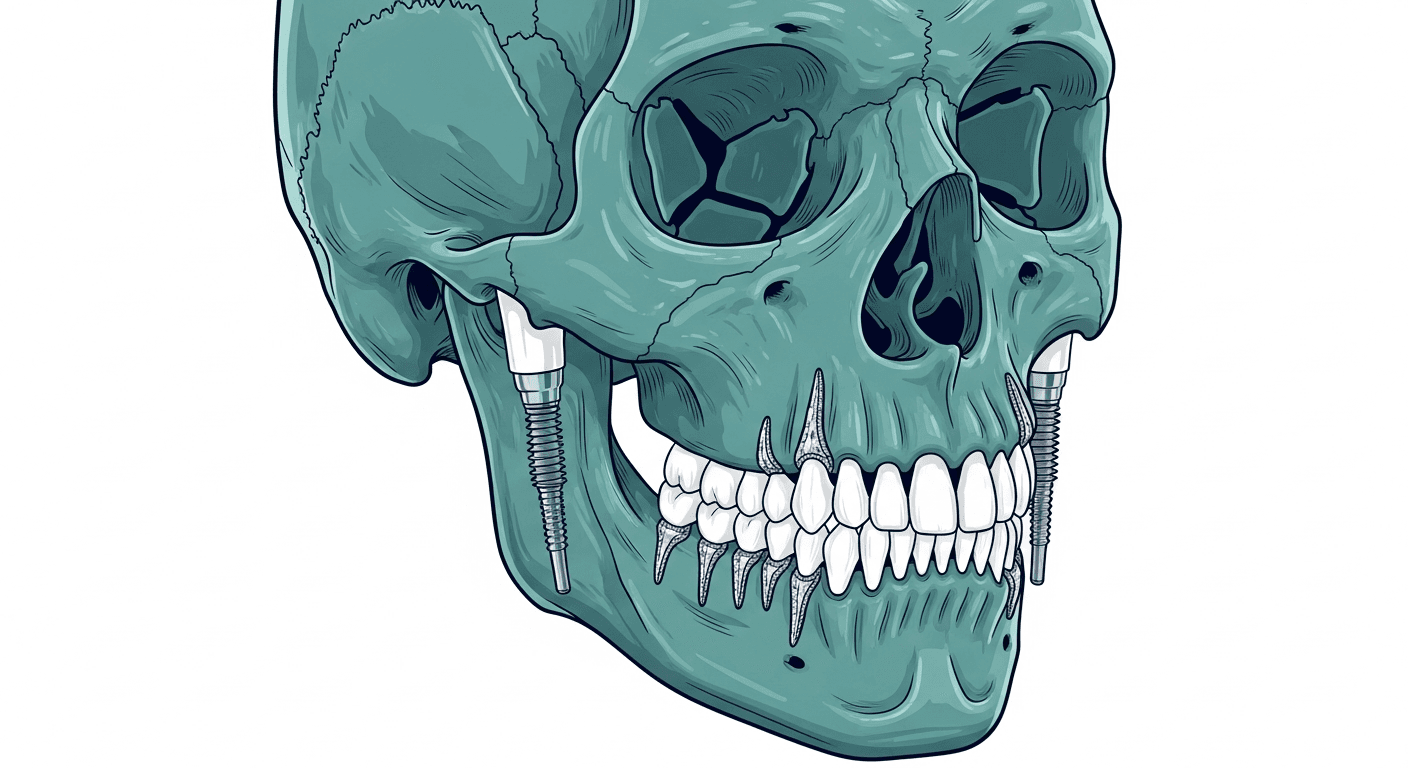
Zygomatic dental implants are an advanced implant technique used when severe bone loss in the upper jaw prevents placement of traditional implants — anchoring in the zygomatic bone (the cheekbone) instead of the maxilla for dense, stable support. At the practice of Dr. Alexander Antipov, a board-certified oral & maxillofacial surgeon in Roseville, CA, this procedure is reserved for complex cases and requires advanced surgical training.
This article is for general education and is not a substitute for a personalized evaluation by a qualified oral surgeon.
Why Traditional Implants Fail in Severe Bone Loss
In the upper jaw, long-term tooth loss often leads to a cascade of changes that undermine conventional implant placement:
- — Vertical bone resorption that reduces the height available for an implant.
- — Sinus expansion that pushes downward into the space where bone once was.
- — Insufficient bone height for reliable implant stability.
In extreme cases, even extensive bone grafting cannot reliably recreate adequate bone for traditional implants. That is the point at which a different anatomical anchor becomes necessary.
| Factor | Traditional Implants | Zygomatic Implants |
|---|---|---|
| Anchor site | Upper jaw (maxilla) | Zygomatic bone (cheekbone) |
| Bone required | Adequate maxillary bone height | Works despite severe maxillary bone loss |
| Grafting | May require extensive grafting | Can avoid massive grafting |
| Complexity | Routine implant procedure | Advanced technique for complex cases |
What Makes the Zygomatic Bone Different
The zygomatic bone offers qualities the resorbed upper jaw cannot:
- — It is dense cortical bone.
- — It resorbs minimally over time.
- — It provides high primary stability.
By anchoring implants into this structure, surgeons bypass the need for massive grafting.
Implant Design and Placement
Zygomatic implants differ from conventional implants in both length and trajectory. They are:
- — Significantly longer than conventional implants.
- — Placed at an oblique angle.
- — Anchored partially or fully in the cheekbone.
Placement requires precise 3D planning and careful avoidance of critical anatomy such as the sinus and orbit.
Indications for Zygomatic Implants
Zygomatic implants are typically used when:
- — Upper jaw bone loss is severe.
- — Multiple grafting procedures have failed.
- — The patient desires a fixed solution without prolonged graft healing.
They are not a first-line treatment.
Risks and Complications
Because of their complexity, zygomatic implants carry specific risks:
- — Sinus complications.
- — Soft tissue irritation.
- — Prosthetic design challenges.
These risks increase dramatically when the procedure is performed by inexperienced providers.
Immediate Load Potential
Many zygomatic cases allow immediate loading due to high primary stability. However:
- — Prosthetic design must be rigid.
- — Bite forces must be tightly controlled.
- — Maintenance is critical.
Immediate load does not eliminate long-term risk.
Why Few Clinics Offer Zygomatic Implants
This procedure requires:
- — Advanced surgical training.
- — Hospital-level planning.
- — Multidisciplinary coordination.
Zygomatic implants are not common because they should not be — they belong to a small set of complex cases handled by experienced surgical teams.
Frequently Asked Questions
When are zygomatic implants needed instead of traditional implants?
Zygomatic implants are used when severe bone loss in the upper jaw prevents stable placement of traditional implants. In the upper jaw, long-term tooth loss leads to vertical bone resorption, sinus expansion, and insufficient bone height. In extreme cases, even extensive bone grafting cannot reliably recreate adequate bone, so implants are anchored in the dense zygomatic bone (cheekbone) instead.
What makes the zygomatic bone a good anchor for implants?
The zygomatic bone is dense cortical bone that resorbs minimally over time and provides high primary stability. By anchoring implants into this structure, surgeons bypass the need for massive grafting in the upper jaw.
Can zygomatic implants be loaded immediately with teeth?
Many zygomatic cases allow immediate loading because of high primary stability. However, the prosthetic design must be rigid, bite forces must be tightly controlled, and maintenance is critical. Immediate loading does not eliminate long-term risk.
What are the risks of zygomatic implants?
Because of their complexity, zygomatic implants carry specific risks including sinus complications, soft tissue irritation, and prosthetic design challenges. These risks increase dramatically when the procedure is performed by inexperienced providers, which is why advanced surgical training and careful planning are essential.
Why do so few clinics offer zygomatic implants?
Zygomatic implants require advanced surgical training, hospital-level planning, and multidisciplinary coordination. They are not a first-line treatment and are reserved for complex cases, so they are uncommon by design rather than by availability alone.
Are zygomatic implants a first-line treatment?
No. Zygomatic implants are not a first-line treatment. They are considered when severe upper-jaw bone loss makes traditional implants unreliable and when grafting is not a dependable option. A thorough evaluation determines whether a patient is a candidate.
Sources & References
Peer-reviewed and authoritative references supporting the information in this article.

Dr. Alexander V. Antipov
Board-certified oral and maxillofacial surgeon specializing in dental implants, full-arch restoration, zygomatic implants, and corrective jaw surgery. Serving patients throughout Northern California and beyond.
Get an Honest Assessment for Complex Cases
An accurate recommendation is only possible after an in-person exam and a 3D CT scan. The consultation is complimentary, and we recommend the most appropriate solution for your situation — not the most complex one.